

Danny Cooper runs a basketball training academy in Bala Cynwyd, PA, where he trains 80 to 100 athletes per month. He started in his backyard at 20 years old with a half-court his dad built, charging $200 a month. When he went full-time, he had already figured out the model: monthly memberships, a small trusted team, and a training philosophy built around real game situations rather than isolated drills.
In this episode of the CoachIQ Podcast, Danny talks with host Mitch Kirsch about how he built the academy, what he learned from working with NBA Dunk Contest champion Mac McClung, and how he manages 600+ families without the admin chaos most trainers live with.
Who is Danny Cooper
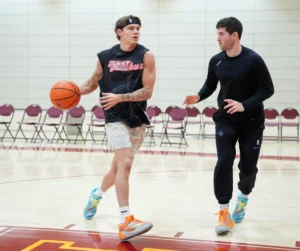
Danny Cooper is a basketball trainer and academy owner based just outside Philadelphia. He got his start training players in high school, then expanded when he began interning for NBA skill trainer Drew Hanlon in 2021. That experience introduced him to the constraints-led approach to player development — a framework that would shape everything about how he works.
He met Mac McClung during that internship and the two have become close training partners. Mac has gone on to win the NBA Slam Dunk Contest twice and continues to develop his game with Danny in the summers. Danny also works with other professional players, including Lamar Stevens of Paris Basketball.
On the basketball training academy side, Danny trains youth and high school players in Bala Cynwyd — 80 to 100 athletes per month — with plans to expand to a second location within the next year.
The basketball training academy membership model that drives recurring revenue
Danny first learned the monthly membership model from Drew Hanlon at a seminar. The idea: instead of charging per session, players pay a recurring monthly fee to come one, two, or unlimited times per week.
When he was still in college, Danny ran that model in his backyard. He had around 45 kids paying $200 a month — all from six to eight hours of work per week.
“I was like, this is crazy,” he said. “So I think a lot of times, like when I first started in high school, I would start out with the individual training and the one-on-one.”
When he went full-time, he formalized the model. Today his academy offers three membership tiers — once, twice, or unlimited per week — across 16 hours of group workouts each week. That consistent monthly revenue is the foundation the whole business is built on.
He still does high-ticket private training for select clients, but the membership model is the engine. That consistency is what gives the whole business a foundation. See how other academy owners collect payments automatically without chasing cash or Venmos.
For more on why the group model works economically, see Group Training vs Individual Sessions: The Economics.
Why Danny’s basketball training academy runs zero drills with advanced players
At the professional level, Danny’s training looks nothing like what most people picture. With Mac McClung, there are no cone drills, no isolated skill repetitions, no scripted footwork sequences.
“When we work out, we never do any drills. It’s literally just putting him in a game situation and trying to challenge him,” Danny explained.
In practice, that means two-on-two paint work with ball screens to build passing reads, full-court pickup to work on conditioning and defense, and open-ended exploration sessions where Mac is encouraged to try moves Danny has never even seen before.
“We try to almost make the court as his canvas for him to experiment and try crazy stuff.”
That philosophy — grounded in the constraints-led approach — focuses on decision-making in realistic environments rather than perfecting movements in isolation. The idea is that players trained in live situations transfer their skills more reliably when games are on the line.
This isn’t a new idea. But Danny is one of the trainers actually doing it consistently, and with high-level players who validate the approach. For a deeper look at how coaches apply this in group settings, see Constraints-Led Approach Basketball Training: Jeff Schmidt.
How do you train 100 youth athletes differently from an NBA player?
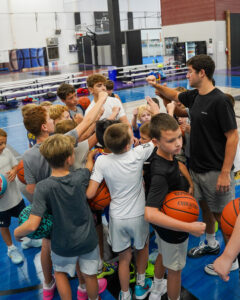
The constraints-led approach doesn’t disappear with youth players — but the execution shifts. With kids, Danny is more direct. He’ll pull players aside mid-session for direct feedback and introduce named actions: horn sets, zoom actions, 45 cuts, burn cuts. Players earn a bonus point in 3×3 games for executing those concepts correctly.
“We want to improve and accelerate that learning curve. So I think being a little more hands-on and kind of not telling them what to do, but showing them some new options,” he said.
He’s also built a basketball IQ library inside CoachIQ — short video clips, concept definitions, and quizzes — that players can access at home between sessions. Homework for basketball players. Shoot 25 threes and track your makes. Watch three clips on 45-cut reads and complete a quiz.
“There’s been a couple of our kids that have really taken that seriously. And we see the results from the workouts.”
How Danny uses CoachIQ to manage 600 families without the admin chaos
At 80-100 athletes per month, communication becomes a full-time job if you let it. Danny doesn’t let it.
He built a list of roughly 600 families inside CoachIQ. He reaches all of them at once using mass announcements and automated reminders — no group texts, no phone calls. When a pop-up clinic goes on the calendar — held on school in-service days and holidays when kids are off — he sends one message to the entire list. The link, the registration form, and the payment are all in the same announcement.
“I’ll send out a mass announcement to my probably 600-person email list in Coach IQ,” Danny said. “I can put the link right there and they go right to it. Typically they’ll fill out a form and then they’ll purchase the product.”
Those pop-up clinics have become a meaningful off-season revenue tool. Thirty kids at $75 each in a single day — no Venmos, no checks, no awkward cash collection after the session.
“CoachIQ has made that a seamless product for us to where I don’t have to collect cash from parents or checks.”
The key takeaway
Danny Cooper didn’t wait until he had a facility, a staff, or a proven system. He started with a backyard half-court and a monthly membership model he borrowed from a seminar. His team got room to grow into their roles. Training Mac McClung for free before Mac was anybody — that’s the kind of relationship investment that eventually pays off.
That’s the pattern: consistent action, a model built for recurring revenue, and tools that handle the admin so you can stay on the court.
If you’re building a basketball training academy, the first move is getting your operations off text messages and spreadsheets. See how CoachIQ helps academy owners manage 100+ athletes without the chaos — and book a free demo to walk through what other coaches are doing right now.
Connect with Danny on his website and follow him on Instagram
Full Episode Transcript
The following is a lightly edited transcript of the episode above.
▶ Click to expand full transcript
Russell: Welcome back to the Coach IQ podcast. I’m your host Mitchell Kersh here with Danny Cooper from Danny Cooper Basketball. Danny, thanks for being here.
Danny: What’s up, Mitchell? I’m happy to be here. Thanks for having me.
Russell: Really excited for this convo. I think you are one of the best grinders in the game. And that as a a huge compliment. I see you doing podcasts. I see you working with NBA players. I see you running a very successful academy with youth and high school players. It seems like you’re you’re doing it all. I want to start off with congratulations on all the success. And also, how are you doing it? Are you sleeping?
Danny: Thank you. I appreciate it. No, it’s it’s been a lot, but it’s been a a fun grind and I couldn’t do it without my team. shout out my guy Nate is my director of content. He pretty much handles all of the content that everybody sees across all platforms. And then my guy Jake who runs my academy. He’s the director of my my youth academy. he’s been helping run that for the last year or so. it’s really just the team I’ve been able to build around me and I couldn’t could definitely not do it myself. but it’s it’s a lot. We juggle a lot of things at once, but that’s just how I’ve always been. Just if I have an idea, I take action. I’m a big big action guy, so just just yeah, just just trying it all. So
Russell: Sweet. How have you been able to delegate in your career? I think that’s something a lot of coaches struggle with, especially when it’s something like basketball training where you feel so personal, personally tied to it. how did you go about that process? Yeah, delegating to be honest has been one of the biggest challenges of my young career. I’ve done my best to be hands off and not micromanage. But to be honest, in the beginning with the content stuff, Nate was new with it around two years ago. He had never picked up a camera, never edited. in the beginning, he would film and then I would chop it up in Adobe and be editing for hours. took me a a long time to come to terms with the fact that I can’t do everything and I need to delegate and have other people. I think the one thing that really helped me was realizing that even if somebody can do something 60 to 70% as good as you, that is worth it because then I can take my time and energy and deploy it elsewhere. And eventually, as you give somebody enough learning curve and enough time, they’ll get really good at it. that’s where we’re at now. And the same thing same same thing with Jake. You just have to be okay with some short-term failure and not as not as good as you and then eventually they’ll become better than you hopefully. So
Danny: I like that perspective. It’s it’s something for me this year that’s a big goal is to to delegate more. So you’re you’re inspiring me to to have those conversations. I like that frame of mind. 60 to 70% is good or up to your standard like that you can work with. I love it. Now, shifting gears slightly. I know we’ve got a little bit of time because you got to get on court with M. McClung. And this is a guy that probably most listeners know. A lot of them people have seen him with on the dunk contest, but he’s also an incredible basketball player on his own. You’ve done a really nice job developing him as he’s been working in the G-League. Would love for you to talk about your relationship with him, how that relationship started, and how you guys have grown together. he’s grown as a player, you as a trainer, and and you helping him to achieve what he’s achieved so far.
Russell: Yeah, for sure. my relationship with Mac, he’s one of my best friends now. And we go all the way back to I interned for Drew Hanlin in 2021 during his pre-draft. And from the first moment that Mac and I met, we just hit it off. And I was always just from a place of of goodwill and trying to provide value and saying, “If you ever need me to come train you, I’ll work you out for free. I I’ll do whatever. So then fast forward a year, I drove down to his hometown, Gate City, Virginia, and I helped him run his camp and trained him for that weekend. And ever since, we’ve been inseparable. Any big moment he’s had at all-star weekend or in the G-League, I will try to be there as much as I can. Mac is one of the most relentless humans I’ve ever met in my life. And he’s just one of those people that when he sets his mind to something, he’s gonna accomplish it or or die trying. Now, in terms of being on court, he’s one of the most unique players I’ve ever worked with, and it it aligns a lot with your philosophy and and the CLA and stuff of that nature. with Mac, when we work out, we never do any drills. It’s just putting him in a game situation and trying to challenge him and he’s big on in the summers being creative. he’s always trying to add new things to his game. obviously we’ll look at the film and try to create a strategic plan that way, but we also just try to almost make the court as his canvas for him to experiment and try crazy stuff. like if you watch some of our workouts, we post some on YouTube or my Instagram. He’ll do some stuff in there like some moves I’ve never even seen before. Something that you couldn’t teach somebody, but I just try to provide that environment for him and he really enjoys working with us because he’s not one of those guys who likes to do rigid drills and rigid training. So yeah, man, just trying to create that fun environment for him to explore, be creative, and we found it to be pretty successful. So
Danny: Yeah, absolutely. I think it’s a timely topic because there’s some videos posted in the past week and an article written in the New York Times about the constraints approach. Kevin Durant doing a lot of small side of games mimicking those live actions. And I think I’ve seen you do this type of stuff for for many years now. It’s something that I’ve been promoting for several years with all the guys that I work with. But I also feel like it’s somewhat getting glossed over as like we’re just playing live and then the player does whatever he wants and and then we keep moving on. But I I’ve seen from what you do like you go in and you have a focus. You said you watch film. There are these principles that stick out. So maybe for for Mac specifically, could you touch on what are the things or the the specific priorities that you’ve been trying to encourage in those environments?
Russell: Yeah, for sure. I think definitely becoming a better passer. in in some of the in some of the workouts, we’ll put him in a a 2v2 in the paint and we’ll set a ball screen in the paint and have him make a pocket pass or a wraparound pass and just try to make it really challenging for him to see those reads and then building it up to 3v3 out of that and, seeing some skips and 2v1s on the weak side and and stuff like that. And then another thing just just being able to make shots out of out of any situation in any scenario and really working on his his conditioning as well. So a big knock on Mack is his defense which I don’t necessarily agree with. So sometimes we’ll have him pick up full court and he’ll get dead tired and then we have to make some shots after that. So those are those have really been our main focuses. But then besides that, it’s just really letting him explore and just putting him in the game as much as possible. He’s probably the best visual and mental learner I’ve ever met. he’s one of those guys that even if he didn’t work out for a couple days, he’s going to get better because of how he how he thinks and just internalizes and and thinks about the game. he’s very unique in that way.
Danny: Very cool. Now, when you have a a player like that with his ability, obviously has had success at the highest level, but then you also have an academy full of kids that are at their foundational levels, Growing up in playing basketball, learning from you guys in your academy. What are the differences in how you would train someone like Mac versus the players starting with you? Yeah, we so we we train 80 to 100 players monthly in our academy outside of Philadelphia. So it’s been pretty good. I would say the main style we do in our groups is live training with decision- making and and small-sided games. I think a lot more with the kids though. We’ll try to be a little more hands-on and if we see something that we feel like they can work on, we’ll pull them aside and then we’ll give them some more explicit direct feedback because I think we only have an hour with them a lot of times like one hour a week. we want to improve and accelerate that learning curve. I think being a little more hands-on and not telling them what to do, but showing them some new options. Whereas a guy like Mac, he already not knows everything, but is such a strong basketball mind that there’s less of that and more of just letting him be in that environment and explore that. I think those are the two main differences for sure.
Russell: Yeah, certainly. You touched on Mac as far as how he thinks about basketball and even those times where he’s not on court. And this is a topic that I’ve thought about a lot with guys who have played so much basketball. They’ve seen so much. And if we ask them to visualize something, even if it’s on air, they’re probably going to be able to visualize it or visualize the scenarios more accurately than somebody who’s just starting out. And if we can allow those players that are starting out to see more basketball when they’re not on the court, then potentially we can help them improve that process. So I know you have the online aspect to your training as well where players they can be in person with you and then when they’re not in the gym, they can do some drills. They see things via I think it’s via your app. Is that correct?
Danny: Yeah. So we’re on the Coach IQ app. I don’t have a personalized app, but it’s through Coach IQ and
Russell: Okay. Yeah,
Danny: We’ve seen that to be really successful. We’ve done things where we we’ll implement homework for the kids. if they’re with us one day a week, they’ll go home and we’ll give them a weekly drill. maybe it’s it could be as simple as shoot 25 threes and see what you make out of 25. And just trying to implement things that they can do at home and build those habits. And then I also build a basketball IQ library where I put different game actions and different, definitions of cuts. 45 cut, burn cut, all this all this stuff where even at 9, 10, 11 years old, they can go home outside of our workouts and they can study this stuff and I made quizzes for it. And the one thing I’ll say, sometimes it’s hard to get those kids to do it on their own. But there’s been there’s been a couple of our of our kids that have really taken that seriously and we we see the results from the workouts. it’s good.
Russell: Yeah, certainly. you meet the players that that want more and you pro you provide them the extra work or the extra resources. That’s a topic. There’s a guy out there Merrick Merrick Clasman. He’s got an app Hooper IQ and that’s one of his huge hypotheses is if we can just improve the overall IQ of players. That’s what’s going to really differentiate. Like everybody’s doing their skill work, everybody’s lifting, but it’s the players that really have the IQ that excel at the next level. And a huge piece of that is is the terminology. It’s seeing actions, being able to repeat them, being able to talk and share that same lingo with coaches, which I think is is really valuable. Now, when you’re promoting skills, the ultimate goal is obviously for these players to to have success on the court within their teams. How do you approach certain things like specific actions or specific cuts with players that might not be going back to the same programs?
Danny: It’s a good question. I think we take a more general approach of trying to just expand their basketball mind as a whole because we want them to be able to plug and play into any program. So yeah, we’ll we’ll go with maybe it’s a a group workout and we’ll teach them porn set, we’ll teach them a get action, we’ll teach them a zoom and like just different things where we try to build on that every week and then typically we end the session with FIA 3×3 for 10 to 15 minutes and try to maybe give them an extra point if they do a zoom or score out of a get and just different stuff like that. I think it’s hard because we have so many players from so many different AU teams and so many different high schools and middle schools that I don’t necessarily know the exact actions their coach is going to be implementing. So I think we take a broader approach with that and just try to build them up as high IQ players and understanding the game and then hope that that translates once they get to their team.
Russell: Yeah, certainly. I like that. And I think for for those players that coaching is very high level for them. So kudos to to you guys for improving the ball out there. And I know you’re you’re you’re killing on the court, but also from a business perspective, I want to talk about some of the evolutions you’ve had as a as a business. How have you landed on this model? Maybe talk about some of the things you were doing previously that you’ve scrapped and and why have you moved away from those things?
Danny: Yeah, so originally I believe I was 19. I I learned the monthly membership model from Drew Hanlin. I went to this seminar that he held. And that’s the first time I was introduced to an academy, a monthly membership model where, you have people coming one or two days a week, you charge a monthly membership. And from the beginning, back in 2020 when I was still in college, I ran an academy in my backyard and I had around I had a little half court in my backyard that my dad built me and I had around 45 kids on like 200 a month when I was 20 years old in college. it was crazy. So to see, that model come to fruition like that for only, six to eight hours a week, I was this is crazy. I think a lot of times, like when I first started in high school, I would start out with the individual training and and the one-on-one. And I still do a little bit of high ticket private training, which I think is still important. But in terms of the monthly membership, when I went full-time a couple years ago, that’s really the model that we implemented. And now we have 16 hours a week that we have group workouts. And we have two or three options that parents can choose from to come once, twice, or unlimited. And that’s how we’ve been rolling. And it’s it’s been a pretty successful model for us to get that recurring revenue and just have that foundation and and healthy business, I would say. it definitely comes with challenges in terms of churn rate and other sports and stuff like that. I’m I’m still working on that every day to try to figure out how to improve it, but it’s been a pretty solid model so far.
Russell: Yeah. Specifically during the season, how have you dealt with the seasonality? Are kids still willing to come and train in season?
Danny: Well, yeah. the cyclical nature is definitely tough. I would I would say between December and February, we still get a good bulk of second through 8th graders. I know a lot of people probably don’t want to work with kids, but that’s something we haven’t strayed away from. we do have a lot of players from age 7 to 12 that maybe aren’t in season during that time. And then the summer for us for the academy model is a little slower because a lot of kids go to summer camps, a lot of kids go to overnight camps in our area. we’ve been able to to combat that with different unique things. one thing we do on inservice days or holidays is is pop-up clinics. we just had one yesterday where kids were off from school. We have 30 kids. we charge $75 for that. that’s a really good way to supplement our monthly revenue even in more down times. that’s a unique approach we we’ve taken with that even in the down months.
Russell: Yeah, I think that’s really smart. There are so many different aspects of revenue for basketball coaches and I think for you to have the the underlying consistent monthly revenue is is more so a security but then you can continually meet players that want more like you said offering the high ticket individual work camps clinics day of the process is it’s important to be organized throughout all of that. what tools specifically? I know you’re using Coach IQ, but what tools specifically for things like a clinic, a camp, email lists? What are you using to to help you manage everything?
Danny: Hey, I just want to take a quick break. My name’s Russell. I’m one of the founders of Coach IQ. We put on this podcast here. Our goal is to interview top coaches and business owners in the youth sports space across the United States and give you guys insight on the ground floor. How are they running their business? What do they think about the current ecosystem? and what are their thoughts on where things are going. we’re super excited to bring this to you guys. If you don’t know about us, we are an all-in-one sports management platform. We run a lot of the businesses that we have on the podcast and we’re fortunate enough now to work with about a thousand sports coaches across the United States and it’s our goal to make your life as easy as possible in running the business itself. Website, scheduling, payment management, everything handled seamlessly on our platform. And really what separates us is we are built specifically for sports. We’re not powering nail salons. We’re not powering Pilates studios. Every second of the day we focus on you. So if that’s something you need where you’re looking to get your time back or you’re looking to grow your business, Coach IQ is really the only platform thinking about you every single day interviewing and working with the top coaches in the industry specific to sports. if that’s something we can help you with, we would love to connect with you. You can visit our website, coachiq.com, schedule a free demo there. The demos are awesome. It’s really less about selling and much more about just walking through what we’ve learned and providing value on what other coaches are doing. And if it’s a match, it’s a match. absolute no-brainer. Go schedule a demo. worth the time. And thank you guys for tuning in. Thank you guys for watching. Thank you for customers who are working with us. It allows us to do all this make better product and the main goal help athletes all across the United States and the world get a phenomenal experience from you guys the coaches.
Russell: Yeah, Coach IQ has been great for us. they really have everything we need. we’ll we’ll create a flyer on Canva. will post on our website and then I’ll send out a a mass announcement to my probably 600 person email list in Coach IQ and I’ll say, probably a week or two before, hey guys, wanted to let we’re having an inservice pop-up clinic next week. And then I can put the link right there and they they go right to it. Typically, they’ll fill out a form and then they’ll they’ll purchase the product. And Coach IQ has made that a seamless product for us to where I don’t have to collect cash from parents or checks. I don’t have to collect Venmos and and worry about payments like that. Coach IQ has made that very very easy for us to track and to to collect revenue. For sure.
Danny: Very cool. All I got two final questions for you. First one’s going to be about content. you you said you have a content manager. Now, you have also your personal page, but then you also have the the business page, correct? Can you talk about your different styles of approaching content, managing content, and how those two avenues have impacted your inperson business?
Russell: Yeah, so for my main page, DUP Bibball, that’s really where our goal of that page is to build my personal brand as a human first and then number two as a highle basketball trainer. So we see that as posting, from high school to NBA, posting highle players where it’s either me teaching them something more explicitly, showing, a certain skill I’m teaching or putting them in an environment like Mac and showing how we train that way and really showcasing my skill set. I feel like I’m I’m I’ve developed a skill set where I can teach in a multitude of ways. So feel like I’m really comfortable with the CLA, but then I feel like I’m also pretty good at with some of our players teaching them specific skill stuff that I think they need if it’s a a footwork thing or something like that. So the goal with that page is to really showcase my skill set and to build me up as a trainer. We try to we try to post two to three times a day on that page to really be consistent and get my message out there. Yeah, we’re we’re pumping, man. But but no, we we the system that we use for that is we’ll just try to film as many highle workouts as we can and then we’ll we’ll batch it up and and try to get out as many clips as we can of that. And then another thing we like to do is post carousels for the from a personal branding side. every Friday night at 9:00 p.m., I’ll post a just a story about my life that maybe people don’t know. And we do like a long 20 slide carousel where people can get to know Danny as the human because one thing I’ve realized is especially trying to build in the online space is anybody can be successful, but you need them to fall in love with you as the person. why would they buy a product from Danny over Mitchell, And that’s
Danny: Right. That’s where I turn the corner where they need to fall in love with me. Even if they like Mitchell’s drills better, if they love Danny, they might buy from Danny. that’s where we’ve been building with that. Now, in terms of the skills academy page, we really post the kids stuff on there. that’ll be anything from, a a twoon two smallsided game in our academy group to a fun miked up clip of asking the kids what their favorite basketball movie is. Just different stuff like that. And we have an intern right now who’s controlling that and she’s doing a really really good job and we’re having a lot of fun with that. So those are the two differences with that page. And then I also just started another page called DCB coaches where I’m going to be sharing my philosophies and using it as a separate place where I can share my philosophies on training, my philosophies on business and stuff like that. So we got a lot going on with that. But it’s been fun.
Russell: That’s good stuff. And to to end the podcast, I will usually ask, “What’s the best way to contact you?” Are you cool if people hit you up on any of those Instagram pages?
Danny: Yeah, for sure. It’s it’s been cool. It’s always fun to connect with coaches and trainers and and just pick their brain. And that’s how I reached out to you. Just reached out to you and wanted to ask you a couple questions. So,
Russell: Yeah. I love it. I love it. All right. My last question. You’re clearly a man of action. you’re you’re pushing the envelope on multiple fronts. What’s the end goal for you? What are you building towards?
Danny: Yeah, I think I’m building towards building a scalable, sustainable business in my backyard, so my homeront. we’re in Balakinwood right now, which is 15 minutes outside of Philadelphia. I have plans to expand to another location around 45 minutes away from there. So ideally, I’m able to build a team around me that can help me run those those one or two locations successfully without me. And then I’ve been fortunate enough to do clinics around the world in Vietnam and Aruba and I’m in talks with doing some more. So yeah, hopefully be able to to travel the world and and impact a lot more players around the world and then also just keep building my high level clientele and we have a lot of really good college players right now and Mac obviously fighting to make the NBA. So just Lamar Stevens with Paris basketball. So just hoping to continue building that personal brand and and gaining new highle clientele but then also having that impact and sustainable healthy business on the home front. it’s a lot at once, but I think we’re doing a pretty good job and just got to keep plugging away day by day.
Russell: Well, I’m a fan. I’m rooting for you. I’m also a believer. I think everything I’ve seen from you and and the intense action you take, it always tends to work out for those type of people. So would highly encourage anybody out there listening, go follow Danny, stay tapped in, and maybe we can we can do a little update episode a year from now and see how much you’ve grown, what’s what’s changed. I I would be willing to bet a lot of the players you’re working with are are going to be much improved by then. we’ll have some cool stories to tell.
Danny: Awesome. All right. If you guys want to contact Danny, you want to just give one final plug to your your Instagram pages? Yeah, it’s just doopbball on Instagram and and then Danny Cooper basketball on YouTube. Those are the two main places I guess you can find me.
Russell: Awesome. All right. Thank you, Danny. Hey, man. All right. Really appreciate it.
