

Evidence-based basketball training is transforming how smart coaches develop players—and Freddy Webb’s journey shows why. You’ve watched a player drain 50 jumpers in warmups, then miss every shot when the game starts. Freddy lived that frustration, shooting 500 shots a day in college and still struggling to score in games.
Evidence-based basketball training means designing practice environments that mirror game demands—using constraints, variability, and self-organization instead of prescriptive technique drills. It’s the difference between players who perform in practice and players who perform when it matters.
Freddy is a professional player in Australia’s NBL1, a trainer who’s worked with NBA veterans including George Nang and Duncan Robinson, and the founder of Adapt Basketball. His journey from Darwin—a remote town of 120,000 people—to training elite athletes offers a masterclass in evidence-based player development.
In this episode
- Why the “make 1,000 shots” approach failed Freddy as a player—and what actually works
- How growing up with scientist parents shaped his training philosophy
- The constraints-led approach explained through real examples
- Building a training business through word of mouth and authentic content
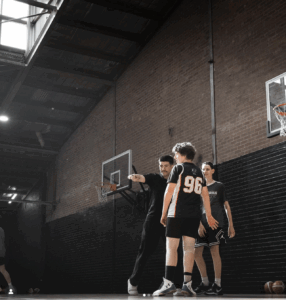
How a scientific background led to evidence-based basketball training
Freddy’s father is the world’s leading expert on saltwater crocodiles. Growing up at the family’s research center, Freddy absorbed something beyond work ethic: the scientific method. His dad taught him that good science means trying to disprove your hypothesis until you can’t.
This mindset eventually collided with traditional basketball training. In college, Freddy was first in the gym at 5 a.m., making 500 shots daily, outworking everyone.
And he still couldn’t shoot well in games.
“It can’t just be a reps thing because I’m shooting four times as much as everyone else here and I’m still not shooting well in the game.”
The hypothesis that more reps equals better performance kept getting disproved. This led Freddy to skill acquisition research and the constraints-led approach—an evidence-based basketball training methodology that matched what research shows about how humans actually learn movement skills.
Evidence-based basketball training: the constraints-led approach in practice
The shift wasn’t just intellectual. Freddy started experiencing breakthroughs immediately.
“Every training session, I was doing something I hadn’t done before. I hit a jumper and jumped like two feet in the air—I had never jumped like that because I didn’t think I could shoot the ball differently twice.”
The old belief: shoot the exact same way every time. The new understanding: you need to put the ball in the same place (the hoop), but how you get it there can—and should—vary.
This aligns with the constraints-led methodology Jeff Schmidt uses at Schmidt Performance—designing environments that force adaptation rather than prescribing solutions. Both coaches arrived at the same conclusion: the environment teaches better than verbal cues.
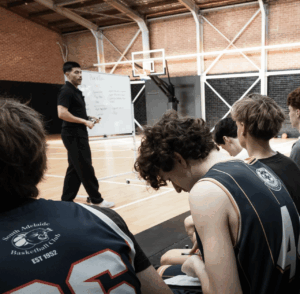
Teaching beginners with evidence-based basketball training
The most common pushback against evidence-based methods: “How do you teach fundamentals to beginners?”
Freddy starts with equipment. Lower the hoop. In Australia, kids play on full-size hoops at age 10. In Europe, they keep hoops lowered until 14. European kids develop more functional mechanics because they’re not compensating for strength limitations.
Beyond equipment, Freddy creates representative challenges rather than isolated drills.
“I might pass and give him a mini close-out. I’ll block it once or twice. After the second time I block it—without telling him anything—the kid starts to get lower. He opens up his hands. He’s figuring it out himself.”
Within three sessions, kids who couldn’t finish with their left hand in isolation are making contested reverse layups—because the environment required them to find that solution.
The key insight: kids are smarter than coaches give them credit for. When Freddy asks teenagers to create their own differential learning workouts, “some of the stuff they come up with is brilliant.” This creativity—and the joy that comes with ownership over development—gets lost when coaches over-prescribe technique.
Why traditional coaching fails the transfer test
Early in his career, Freddy ran the standard approach. Line up, make 10 left-hand layups in a row, then go play live.
“Do you think they even attempt a left-hand layup? No.”
The skill existed in isolation but didn’t transfer. This connects directly to why traditional session structure fails—the gap between practice and game performance comes from environments that don’t represent real demands.
The transfer problem isn’t a player issue. It’s a training design issue.
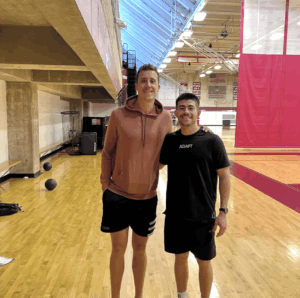
Evidence-based basketball training with NBA players
Freddy recently worked with George Nang and Duncan Robinson. Both are veterans with efficient shooting numbers. The biggest shift wasn’t the constraints approach—they already understood game-realistic training. It was differential learning.
“Both were taught to shoot the ball the same way each time. Now they’re getting older, people are closing out like crazy. The NBA is trying to run people off the line.”
The solution isn’t more reps of the same shot. It’s building ability to score from varied positions and release points.
“You don’t need to shoot the ball the same way. You just need to put the ball in the same place—the center of the hoop.”
What keeps elite players engaged? Challenge. They’ll make 10 out of 10 standard shots—that’s boring. Variability and novel constraints keep training engaging after thousands of workouts.
Building a training business from remote Australia
Darwin is twice the size of Texas with 250,000 people. The closest city with basketball infrastructure is a 3-hour flight away.
Freddy’s approach: word of mouth and consistent content.
“Parents tend to be very proud of their kid working out with someone they feel is doing a good job, and they’re quick to talk about it.”
This referral-first approach mirrors Russell Reeder’s blueprint for $100K+ coaching businesses—systems matter, but word of mouth remains the foundation.
For social media, Freddy sees it as necessary but not primary. Posting valuable content keeps him top of mind. But the foundation remains delivering results parents want to talk about.
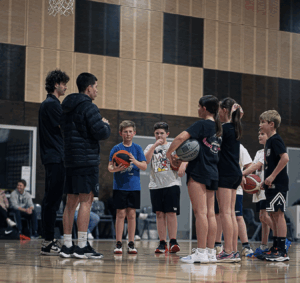
The systems that support evidence-based training
The irony of evidence-based basketball training: the real work happens before the session. Designing effective environments takes more thought than running preset drills.
That means admin needs to run itself. When scheduling, payments, and manual reminder texts eat into planning time, training quality suffers.
Tracking each player’s development requires centralized session notes and progress tracking to stay organized across dozens of athletes.
Tools like automated scheduling and payment processing free up 10+ hours per month—time you can spend designing environments that actually develop players.
Connect with Freddy
Find Freddy on Instagram at @adaptbasketball_ for training content and evidence-based approaches to player development.
Ready to focus on what matters?
Designing evidence-based training environments takes preparation time. CoachIQ gives you 10+ hours back per month—time you can spend planning sessions that actually transfer to games.
Full Episode Transcript
The following is a lightly edited transcript of the episode above.
▶ Click to expand full transcript
Russell: Welcome back to the Coach IQ podcast. I’m your host Mitchell Kersh and we are here today with Freddy Webb from Adapt Basketball out there in Australia. Freddy, welcome to the podcast.
Freddy: Mitch, thanks for having me on, man. I’m excited to have this chat.
Russell: Likewise. I would love for you to start with a little bit of background on your hometown. I think many people across the world might know you or have seen some videos of you hooping with some crocodiles and I know that’s a stereotype of Australia, but you really live that life. give us a little bit of background on how you grew up, what childhood was and how basketball played a part of that.
Freddy: Yeah, cool. So yeah, as as you alluded to, I I went viral a little bit earlier this year from Google, which was just a a fun thing that I decided to do, but I think once I tell you a little bit more about me, it’s why. So I’m from a a small town in Australia called Darwin. There’s about 120,000 people and it’s in the far north of Australia. It’s really really remote. onethird of our population is indigenous Australians. There’s for for a a density and land, I guess, understanding, we’re twice as big as Texas. And if you were to double Texas’s population, you’d have about 60 million. We have 250,000 total in the whole state. it’s big and it’s empty and it’s just full of animals and outback and red dirt, you know. I grew up, both my parents are scientists and my dad in 1993 opened up Crocodiles Park, which was a research center originally and then later became a zoo. it’s a crocodile park and a zoo. And my dad’s the world’s leading expert in saltwater crocodiles. And I didn’t know any better. I just grew up and and that was my world. the school bus would drop me at the zoo like it was home and I lived a couple of minutes away from from it. I was there all the time. And I guess before basketball came into the equation, seriously, as everyone does, like I played it because I loved it and and I still do. And then yeah, I guess as I got older, I was very much involved in both. I would I would work at the zoo and then I would go train and play and whatever else. years before this video happened, there was a photo that came out maybe when I was 12 or 13 and I was on my way. I was about to leave the zoo to go to basketball practice. I was in my full practice kit, had my basketball, my shoes, and everything. And I was about to leave, but they were draining a big crocodile pond with about 400 crocs in it. And my dad was like, “Hey, go dribble your basketball in there.” I’m like, “No, not doing that. I got a terrible idea.” And he’s like, “No, no, do it. like it it’ll be a good photo. And I’m God, you’re not you’re not going to win dad of the year here with this one. Hey. I I get down there and I’m so terrified. there’s big there’s crocs all around me. And and sure enough, I I dribble in between a couple crocs and they snap a photo and it’s it’s funny now because, almost 10 years later, I recreated with a video and it goes viral. But, it’s been Yeah, it’s been a it’s funny. I I really believe everyone has an unfair advantage and that’s just this weird intersect of all the different parts that make them them. And mine just happened to be this really unique blend of science crocs basketball. My mom’s Colombian so there’s a bit of Spanish like it’s just a a weird mix and I guess it’s it’s a bit of who I am. I always I love Darwin. I think it’s I’m very proud to be from there. I love being from the outback. Yeah. when I went to college and everything else, it was it was a pretty different background than many people that I met.
Russell: Absolutely. I didn’t realize there was the backstory with the photo, which makes it an even cooler video to go viral.
Freddy: Yeah. Yeah.
Russell: Very cool. And you’re living in Australia in the outback, but basketball is a huge part of your upbringing as well. And for the listeners, Freddy’s a very good professional player currently and trainer. And so you’ve been able to do both and also play in other countries outside of Australia. So for somebody that doesn’t know the development system and maybe yours is even more unique being from Darwin, how does that process go about of continuing in your basketball journey? How are you developing? How do you make it to the States to play in college? How do you eventually go back and play professionally? Can you walk me through that journey?
Freddy: Yeah, for sure. it’s it’s pretty unique. Darwin, it’s unique in Australia than Darwin is more so just because it’s so small and so remote. we we don’t have these representative sides that go and travel every month or to like AO for example over there, but over here even in Adelaide or New South Wales, they have these these teams that go travel. We couldn’t do that. We didn’t have that because it was we were so far away. The closest city to us that had any basketball team was a 3hour flight away, you know. it was very very expensive and it still is very expensive to fly around. I was I wasn’t very good. I just enjoyed playing it. I loved playing it. And I think probably was really important to understand my story is I wasn’t good for a long time. I didn’t make a lot of the teams that many other people made, through under 14s and under 16s, these representative teams, but something that I always had and I attribute it to both my parents, but there’s like a story that sticks in my head about when I really got to appreciate what work ethic was. And my bedroom in the house was right next to my dad’s office. And every morning when I started training before school at about 6:00 in the morning, I’d get up say 5:45, get ready and leave the house by about 6. Every morning I would get up, I would just look to the office and I could see the light under the door every morning and it was like clockwork. There was no, oh, it’s Sunday, I’m going to rest. It was no sad day. Oh, it’s, this is my sleep. It didn’t exist for my dad. And and I saw it every morning. Every morning. Every morning. So he didn’t have to tell me what work ethic was. He didn’t have to say, “Oh, if you want to chase your dreams, work hard.” I saw someone who was at the top of their field and I saw the amount of effort they were putting in on a daily basis. I started training really hard, really dedicating myself, before school. I was lucky enough to have some really good mentors along the way. And look at how it works is there’s under 14s under 16s under 18s and so on. So I didn’t make any representative team until under 18s which was I made it as as the last round bench and then between that bottom age year and the top age year my development really took off and I captained our team that top a year and then here’s the tough part. There’s been a handful of people go to college or play professionally at a club. There was there was a girl that went four years at Bucknell. She was a very good player. She plays down here now. And there was a couple guys that may like may have had a stint well before like I can’t even remember way older than me. So it was really really uncommon. And I got lucky, which I think is something that’s in everyone’s story, where I would do these trainings every morning. And our CEO at the time was a a lady, and she saw me working out every morning. And then one morning, she she pulled me aside and said, “Hey, what do you want to do?” And I told her, “Oh, I want to go to college. I’ve been making my my my game films. I talked to some recruiting agencies and that thing.” and she said, “Well, my nephew is, I think, a year older than you and he’s at a college. I can put you in touch and maybe you can speak to the coach and see what that looks like.” And fast forward about two or three years and that’s where I ended up going to college. it was a yeah, it was a a really cool transition there. I was I went to Central Main Community College for two years and then came back right before CO. I had both my hips operated on. I tore my labum in in both hips. So I had to relearn how to war, jump, all that stuff. And then the process of playing professionally was an interesting one because NBL1 had just started, which is like the the G- League of the NBA, but it’s in Australia is the G- League of the NBL. And my goal was to play in the NBL. That was that was my goal. I wanted to play in the MBL. So NBL1 was the next logical step. And so I came back, I rehabbed, I had a season in Darwin in the Premier League there, which wasn’t didn’t count for much in Australia, but at least I could play and I got some game film. And then I I drafted an email and I had my highlight tape and I sent it to a ton of coaches and I talked to people and I I asked them, look, hey, this is what I want to do. Do you have any connections? Can you help me? And I got on the phone with a bunch of different coaches and was really young and naive about it. Was just I would tell them all I want to play in the NBL. They’re okay, that’s that’s great. a lot of people want to play in the NBL. And I ended up signing with a team called the Mai Meteors who were like a powerhouse in the MBL1 North, which is one of the best, if not the best conference in Australia. And I got there and I was surrounded with MBL players and and my head coach at the time, Joel Carvin, who’s now an assistant in the NBL with the balls. And that kickstarted my mold of who I was going to become as a player because I was surrounded by these great scorers. I wasn’t it was unwise for me to go in there and try and score the ball a ton, you know. it’s right about the same time I read Mastery by Robert Green. And so I was really in this idea of picking a niche about, okay, what am I going to what am I going to do? I don’t want to compete with every other guy that’s six foot reasonably unathletic and can shoot the ball. Okay, I want to niche down to something where, okay, maybe there’s only a handful of pure point guards that are great defenders, that can shoot the ball at a high level, that are elite leaders. And so that year in Mai really molded I think the rest of my career because I I decided, okay, this is what I’m going to become. This is going to be my niche. If I make it, I’m going to make it like this. I’m not going to make it being an undersized scorer. I’m not athletic enough to be like the Chris Chris Light the the short guy who’s great. Like I’m not like that. So what can I do? And and yeah, so I went to work and I and I did that and had my seasons were up and down and and whatnot. And then yeah, fast forward this I just finished my fifth year of playing NBL1. I had a development year with the World Wars NBL team which was a really cool experience and like you touched on I had the opportunity to go play in India’s first ever professional basketball league started this year too. it’s been yeah, it’s it’s been a fun journey and it’s we talked about this before. Had I had I have known what I know now, I think it would have been a drastically different maybe not even a different player. I think I just probably would have had more fun and been a little bit lighter on myself in this like really striving for something because I think a lot of athletes coaches anyway anyone that’s got dreams and aspirations we have this tendency to just always look forward to the next thing like always always and I think you can really lose how far you come along the way like I didn’t make any of these representative teams in this really tiny town and then I was a development player in the MBL you There’s only been one person ever to play in the NBL from Darwin and I was almost the second. it’s it’s been a Yeah, it’s been a fun journey.
Russell: Absolutely. And a common theme throughout that journey is the environment. you touched on it earlier, but exposing yourself exposing yourself to a new environment and then you figure out ways to stand out, survive, advance within that. And I think this relates back to also your upbringing and I want to talk about how the scientific approach like both your parents being scientists that shaping the way you view hard work and maybe just how to view the world and how to come to solutions. You’ve applied that to your planker but now also as a trainer. I’ve personally gained a lot of inspiration from the things that you’ve posted online. I think the way you think about the game is amazing and through this scientific lens is is something that basketball is trending towards. if you could talk about how you approach the game, how you go about designing environments for your players, where is your where is your mindset when you’re looking at basketball and how you can take a player from point A to point B where they eventually want to get to?
Freddy: Hey, I just wanted to take a quick break. My name’s Russell. I’m one of the founders of Coach IQ. We put on this podcast here. Our goal is to interview top coaches and business owners in the youth sports space across the United States and give you guys insight on the ground floor. How are they running their business? What do they think about the current ecosystem? And what are their thoughts on where things are going? we’re super excited to bring this to you guys. If you don’t know about us, we are an all-in-one sports management platform. We run a lot of the businesses that we have on the podcast and we’re fortunate enough now to work with about a thousand sports coaches across the United States and it’s our goal to make your life as easy as possible in running the business itself. Website, scheduling, payment management, everything handled seamlessly on our platform. And really what separates us is we are built specifically for sports. We’re not powering nail salons. We’re not powering Pilates studios. Every second of the day we focus on you. if that’s something you need where you’re looking to get your time back or you’re looking to grow your business, Coach IQ is really the only platform thinking about you every single day interviewing and working with the top coaches in the industry specific to sports. if that’s something we can help you with, we would love to connect with you. You can visit our website, coachiq.com, schedule a free demo there. The demos are awesome. It’s really less about selling and much more about just walking through what we’ve learned and providing value on what other coaches are doing. And if it’s a match, it’s a match. absolute no-brainer. Go schedule a demo. worth the time. And thank you guys for tuning in. Thank you guys for watching. Thank you for customers who are working with us. It allows us to do all this make better product and the main goal help athletes all across the United States and the world get a phenomenal experience from you guys the coaches.
Russell: Yeah. So I think I think everyone that goes down this path of training whether as a player or a coach has this coming to light moment with this type of training because for so long I and I still do have admired and looked up to let’s say guys like Kobe or Steph and all these players and something about really good players that sometimes gets lost is a lot of them don’t necessarily not know but they don’t sometimes they don’t necessarily know why they’re so good or they don’t necessarily understand exactly everything that goes into them being so elite. And I would always hear this sickening work ethic and making a thousand shots and this and that. And and I I subscribed to it. I was that person in college. I was going to be the first one in the gym at 5 a.m. I was going to make 500 shots in the gun and I was going to keep doing that. And I remember I I feel like I kept getting in this situation where I I wouldn’t be shooting the ball great during a season. And the coach would come in and he’d say, you guys aren’t shooting enough, outside of trainings. And I’m it’s not a rep. It can’t just be a reps thing because I’m getting more reps than everyone else here. it can’t just be bad. And going back to the scientific part, something my dad always taught me is really good science is trying to disprove your hypothesis in every possible way until you can’t. At which point your hypothesis must be true, And and all these things that I kept hearing, I was just able to disprove it quick enough oh, it’s all about reps. Well, it’s not because I’m shooting four times as much as everyone else here and I’m still not shooting well in the game. And so I wrestled with that for a while and I and I used to think there’s got to be there’s got to be a way. There’s got to be a way. And and I was almost to the point where maybe there isn’t a way. Maybe it is just a just a reps thing and it’s just an effort thing that some people have, some people don’t. And then I came across the CLA and then I became to understand and learn more about skill acquisition not from the information processing lens which I’d been taught at university and and just through my own studies and it was what it was really freeing and it it almost it allowed me to do things that I didn’t think I was able to do because I hadn’t practiced them a thousand times. before and I had this really crazy transition. It was when I was with Ilawa that it was happening and I was starting to apply it to my training sessions and I was starting to do it and it felt like every training session. I was doing something that I hadn’t done before like oh man I just I just hit a jumper and I jumped like two feet in the air it felt like and I had never jumped like that because I didn’t think I could shoot the ball differently twice because I thought I was meant to shoot the exact same way every single time, you know? Or like I shot it leaning to my left. Well, I wasn’t perfectly on balance. Isn’t that what I was meant to be doing? And as this kept happening, it was just reinforcing that this was such a better way to train. And then when it came to training kids, I’ll be the first person to say it. I used to have my kids line up and go, “All right, we’re just not even going to dribble. We’re just going to go left, right, left hand, layup, but we’re not moving until you can make 10 in a row.” because I thought, as long as they’ve got that down packed, then we can build out to all this other stuff. And and it’s it’s funny now because now I’m just the complete opposite almost. I I the way I think about it now is, I have a kid and I always do a bit of an intake process with them to understand where they’re at and how old they are, the teams, all the rest of it. And then, then design environments accordingly to target some of the things that I’ve either been able to watch on film or they told me that they want to get better at. But it’s all in this fun, competitive, non techchnied driven environment that people just enjoy. And and I I am always astounded by the things that I see a kid do that I’m if I had trained you the way I did, we’d still be trying to make left-hand layups. Yet here you are making a left-handed reverse layup with defense because the environment required you to find a solution. and I constrain you to only finishing with your left hand and using one dribble. And so when I started seeing that, it reinforced this. The other side of it too was I’m sure you’ve experienced this probably earlier in your coaching days as well was I would tell a kid, hey, you should have used, you should use your left hand more or even question them what could you do? What could you have done there? And they say, oh, well, I could have used my left. They acknowledge it. And then you go play a game or you do this, make 10 left hand layups in a row, and then you go play live. And do you think they make a do you think they even attempt a left hand layout? No. Right. And so it wasn’t it wasn’t it it just wasn’t jelling. We could make a 100 left hand layups in a row. You could tell me that you have to use your left hand and you still wouldn’t do it in a in a game like scenario. So I was wrestling with that. And then when when I came across the CLA it’s like it all clicked. I was watching these kids do this in a game-like scenario and then when they would just play live, they might not go to it directly, but they felt like they had that ability to go and do it because they had done it in a representative environment. And and so it’s been so cool. It’s been so fun to see these kids enjoy themselves and develop and get better and the messages you get from kids and parents about how how much better they feel. And it’s something that I I took away and and I I’m not just saying there’s something I took away from our time was just the the joy in it all. sometimes I reflect on on some of my coaching, especially when I’ve got the whiteboard out and I can be really serious about, this and that and the rest of it, but I think I think energy is is contagious. I think when you when there’s a baseline of just positivity in the room, people are more open to trying things. missing isn’t seen as the end of the world. People are willing to not define success just by making mist. So the training environment has been unreal this last probably last two years.
Freddy: The thing I am most interested by and what you just talked about is the age of the players. And for context on on why this interests me, Freddy, you saw a few weeks back, Freddy came to the US, was was lucky to have him come over and and help out with some of the workouts. he helped out with one workout with George Nang of the Utah Jazz, one with Duncan of the Detroit Pistons. I’m I’m repping some Detroit Pistons gear right here, which wasn’t gifted it wasn’t gifted to me by Duncan. was gifted to me by another player that you helped out with, Jordan Miner, who plays in the G-League, who had a little training camp with Detroit.
Russell: He was just trying to get rid of his gear, but it worked out because obviously Duncan’s there.
Freddy: But that’s where the bulk of the work that I’m doing with CLA is shown. I’m working with high school, college, and NBA players. And so a player comes to me, they are already established in their their baseline abilities with basketball. And I would say one of the biggest questions I get is, “All right, yeah, this is all good and I think it makes a lot of sense, but how do you teach a beginner? How do you teach them the quote unquote fundamentals?” So what do you say to that question having so much experience with youth players? Yeah, it’s a it’s a good one and I think it’s it’s challenging like it’s one of the more challenging things and you rack your brain and this is where I think coaching using the CLA method maybe in the session itself to the naked eye looks like man this coach isn’t given any instruction he’s just letting things go like all these sorts of things but what they don’t realize is coaching using this method I find that so much of the work and effort goes into the preparation of it and into the thinking of, okay, here’s a here’s a a 10-year-old kid that can, barely do a layup or can barely shoot. how in the world am I going to get him to shoot with any consistency or attack the basket without just explicitly telling him to, load his hand and catch a ball and tuck your elbow and all these sorts of things. I’ve played around with a lot of different things. I think very low hanging fruit with young kids is to lower the hoop because a lot of it is a strength issue. a lot of it is is just a strength issue where they have all these weird compensations because they’re trying to get the ball up to this hoop. And it’s something that I found out in Australia, we lift the hoop up when they go into under 12. it means they’re 10 and 11 and they’re playing on a full size hoop. In Europe, they have it down until under 14s. I think that makes a lot of sense. And I think that’s is one of the reasons that kids probably come across with much better or even not even better just much more functional shooting techniques at a younger age because they haven’t had to figure out a way to get it up to 10 ft. So I think that’s one way. I think another way is is playing around with maybe I’m like off here, but in terms of the defining success for these young kids, like I’m not really interested in in a 10-year-old being able to make seven out of 10 shots, that doesn’t particularly matter to me. if if the kid, can repetitively get it off under somewhat of a game-like condition. Like I might pass and then give him a mini close out and, I’ll block it once or twice. And guess what? After the second time I block it without me telling him to, hey, get better shooting preparation, the kid starts to get lower. He starts to open up his hands and and then he, he’s starting to figure it out himself. And don’t get me wrong, if I think someone is struggling and they they can’t seem to figure out what they could do to to become functional and then find a solution to the problem, then I’ll probe them. But I I rarely rarely rarely tell them. It’s very much like a, hey, what could you have done here? What what did you see? Why why did you get blocked? And and I think a lot of that too is kids are so much smarter than we give them credit for. Like we especially as coaches like to think that we know better because we’ve done this for so long. There’s a I’ve seen so many people with this technique which means this is probably the way it should go. And and I don’t subscribe to that at all. like I I think kids are so much smarter and I think when you question them you can be really taken back by just what they understand and what they don’t. And I’ve played around with the little bit of an older age group, like the under 14s, under 16s, and I’ll say to them, “All right, we’re going to create a DL shooting workout. you create a shot, you create a shot.” And some of the stuff they come up with is is brilliant. this is this is unreal, like this this is fantastic. I’m going to go take and use this. And that that also talks to like how much more creative kids brains are and how many more things they see and and interpret before they get conditioned to think a certain way. So yeah, I I get that. I get that question as well, oh, how do you what if someone doesn’t know how to do this? And and I it’s not always easy, but for the most part, I say if you put the effort into designing the environment enough and really think outside the box and be creative and blow the hood, change the ball size, like just be willing to try something that doesn’t work. You can often see some of these things emerge that you never would have thought could have emerged unless you explicitly told them.
Russell: Absolutely. changing the environment, changing the task, altering those constraints, and then seeing what happens. And then I think there’s the acknowledgement that you don’t have to be right on your first go, and you can continually tinker and tweak things to change the interaction between the people in front of you and and what they’re doing in the space that you’re in. I think that’s awesome. And and
Freddy: I’ve got a quick question.
Russell: Yeah. Yeah.
Freddy: For you. Sorry to interrupt. My bad. I was just going to say I’ve got a quick one for you. When you started training some of these guys like let’s say Duncan and George and I don’t know what their previous trainers were like and what they did but I imagine they probably didn’t do as creative of the things as they’re doing with you. How was the initial uptake to that style of training? And did you go to the effort of giving some, explanation of, for example, of introducing noise into the system and having your body selforganized to figure things out? Did you bother saying any of that stuff or did you just say like how how did you go about that and how was the uptake?
Russell: The very first workouts were highly CLA and very game-pecific actions. And for those two guys, I think they’re two of the smartest players in the NBA and have a really sound understanding of what development is. Like you look at them as players. They are underdogs. Most people thought they would be out of the league and then they’ve developed really successful careers and are incredibly efficient. And so they’ve proven to continue to develop throughout their time in the in the league. So they I think they are a little bit more attuned to or think favorably about evidence-based basketball. the constraint approach. So they they’re seeking these environments. So that was I would say easy where we’ve had some discussions is on differential learning. That has been I think one of the points where they’ve made the biggest mental shifts where both of them were taught growing up to be trying to shoot the the ball the same way each time. And now as they’re progressing in their careers, they’ve both shot the ball extremely well over their careers in especially in the NBA. And now they’re getting older. People are closing out like crazy. The NBA in general is trying to run people off the line. So it’s how can we still get off as many three-point shots and maintain or improve efficiency? And for those guys, they’re so elite at shooting the ball in different ways, even when they thought they were shooting it the same way. But now, like making that mental switch, like you talked about earlier, that you don’t need to shoot the ball the same way. You just need to put the ball in the same place, meaning in in the center of the hoop.
Freddy: Yeah.
Russell: Maybe a little further back. Hopefully, we can hit a Brad. But applying a lot of variability to what goes into putting the ball there has been, I think, two of their areas of of a lot of growth. And that came with more conversation about what’s happening in the body when we’re shooting. It’s not this thing called muscle memory. It’s more a process of self-organization. And once we made that shift,
Freddy: I don’t think you want to be controversial on the podcast. Huh. Muscle memory doesn’t exist. I’ll go on record saying that. You can come and holler at me, anybody out there. We’ll have a good debate on it. but yeah, th for those two guys, I think I think that’s that’s been the biggest shift and I’m I’m super grateful that they’ve trusted everything I’ve thrown at them and and we’ve had some some debates throughout, but they those two guys are very smart and very open-minded to development, which is especially cool since they’re they’re veterans in the NBA and have already had a long history of success, but they’re not they’re not content with where they’re at. they’re still trying to improve, which is a cool a cool aspect when they’re
Russell: Past their their 30-y year mark.
Freddy: And I think that was that was something that I saw when I was with you was, you’d throw all sorts of cool interesting variability into these shooting things and not once like did they even blink about what you were saying, or like why would I why would I put 80% of pressure on my right leg and 20% on my left leg? like they didn’t even it was just like yep cool doing it and that’s obviously a testament to the relationship that you have with these guys and the trust that they have in you but it’s it’s also cool to see it at such a higher level them embracing it and accepting it which is something that is is different it’s not it’s not the common way to train it hasn’t been the common way to train so I I think that’s very cool
Russell: Yeah certainly and for those two guys another aspect that is highly motivating for them is is purely challenge. Like they will both get bored if we were to just say, “All right, shoot 10 in a row.” They’ll probably they’ll they’ll make 10 out of 10 most of the time. Like they’re so elite at that type of stuff that it’s just completely boring. And so when you give them any challenge to keep them engaged and and have some novelty, that’s exciting to them. And especially when you’re at that age, however many workouts they’ve done, the season’s long, like you got to keep things engaging and exciting. So that’s that’s another piece to it all is just just keeping things fun. And if you can encourage people to to enjoy that process or not even encourage, but just set the standard for we’re going to do things that are right on that line of of challenge versus your skill. Get into flow state. that’s really where like progress can be made and they’ll just want to keep keep working out which is a good a good thing. I want to end on maybe a slightly different note just talking about how you’ve built up your business and some strategies there. You’re obviously still playing but you also run a very successful business. So if you could talk about first your your strategy of acquiring kids, how have you built your program up to the size it is?
Freddy: Yeah. So I think the simplest way that that grows is word of mouth. Parents tend to be very proud of their kid working out with someone that they feel is doing a good job and they’re quick to talk about it. So that’s probably been the number one way is is that growing. The the other thing to keep in mind because I’m playing is that I have a semicaptive audience from the fans and the kids that come to watch me play. So I can leverage that into come and train with me. And then and then that like as long as you have more people referring people other athletes and kids and parents to yourself than you have dropping out then it’s a positive some equation it’s going to it’s going to keep growing. So I think that’s the predominant way. Then you obviously go into the social media stuff. I think more now than ever that is is a must and it’s a it’s a catch 22 because I don’t think in general social media is necessarily a great thing for society and I don’t particularly love needing to be a person on social media all the time. But I think what it does do and what I’ve I have found is that when you post consistently and and you are putting out valuable content one it can help people. I think that’s always a good thing. If I helped one person with one of my posts and that’s a win. Two, it keeps in front of mind. So something comes up some coaching opportunity or a development whatever it may be. If people can just, recency bias, if they just saw you talk about something basketball wise, they might go, “Oh, Freddy from Adapt would be a good candidate for this.” So I think they’re they’re probably the main methods I’d say of acquiring kids. Yeah, I think there’s no better marketing than than word of mouth. And so many people get caught up in these sneaky ways of of growing the business, but reality is if if you’re a good trainer and the people enjoy working with you and they get better, your business will take care of itself. And you’re clearly an example of that. Well, now we’ve we’ve gone much longer than I originally thought we would, but the conversation was really rewarding for me personally. I want to first thank you for coming on and secondly,
Russell: Of course, man. I’m I’m Should I keep going or you want
Freddy: No, no, it’s it’s the the lag from I’m in London right now. lag from London to Australia. But well, I guess I would love you to to plug where people can connect with you if they want to get in touch. What’s the best way?
Russell: Yeah. it’s just Adapt Basketball on Instagram and on Facebook, I guess, as well if you want to. But Instagram is probably anywhere I put stuff up very inconsistently. But anytime I have a something worth sharing and I have spent the time to sift through the amount of content that is there yeah it goes up there. So it’s it’s good fun. It’s awesome.
Freddy: Awesome. Freddy, thank you. Until next time,
Russell: Mitch. Thank you, man. Appreciate it. I had a great time.
