

Running a private training business in a small space might sound limiting—until you hear how Michelle Toy turned a 10-foot-wide strip of turf into a thriving youth sports coaching software success story in one of the most expensive markets in the country.
Michelle is the founder of Toy Soldier Training in San Jose, California, where she trains youth athletes ages 6-18 with a focus on speed mechanics and foundational movement. She’s also the first woman in California to win state strength and conditioning coach of the year at the high school level. In this episode of the CoachIQ Podcast, Michelle shares how she transitioned from over a decade in high school athletics to running her own business—and the systems that made it possible.
In This Episode
- Why California’s zoning laws forced a creative small-space training solution
- The transition from high school strength coach to full-time private trainer
- How switching to automated scheduling saved hours of daily admin work
- Managing groups of 8-10 athletes in limited space with role-based engagement
- Building transparent cancellation policies that protect your income without damaging relationships

From Parks to Private Space: The Reality of Training in Expensive Markets
Michelle didn’t plan to train athletes in a compact private space. Like many trainers, she started at local parks—and experienced every frustration that comes with it. Soccer balls flying through sessions. Other people claiming her spot. Rain cancellations that cost her income.
“I really wanted to be able to have a spot where no matter what the weather was, I could still train,” Michelle explains. “It wouldn’t be the determining factor whether I could go or not.”
Her solution? A 45-yard strip of turf, 10 feet wide, with 20 yards of tent coverage for rain and sun protection. In San Jose, where industrial zoning laws actually prohibit fitness centers in warehouse spaces, this small-space setup became her competitive advantage rather than a limitation.
For coaches in high-cost markets, Michelle’s story offers an important lesson: the facility you dream of might not be the facility you need to build a successful business. What matters is having a consistent, weatherproof location where you control the environment. (For coaches ready to make the leap to their own space, Tyler Leclerc’s facility journey offers a roadmap.)
The Youth Sports Coaching Software That Changed Everything
Michelle launched Toy Soldier Training in January 2024. Within her first week, she signed up for CoachIQ—a youth sports coaching software platform—but admits she didn’t use it to its full potential for the first year and a half.
“At first, I didn’t use the scheduling side and all the offerings to its full ability,” she says. “I wanted to have a place that was professional, that if people asked ‘who’s that girl in the corner,’ I could give them a business card that actually came to a professional coaching website that looked good.”
The turning point came in September 2024, when Michelle finally switched to CoachIQ’s scheduling automation and client portal. The difference was immediate.
“I would spend an hour every morning just being able to say to everybody, ‘Hey, reminder, we’re at this time today at this field. Are you coming?'” Michelle recalls. “When I finally went over to that, it was a game changer.”
Before the switch, she had no way to fill cancelled slots. If a session was full and someone dropped out last-second, other families couldn’t check availability and grab the spot. Now, parents manage their own bookings through a centralized client portal, and Michelle’s mornings are free for what matters—training athletes, not managing text threads.
Making Small Spaces Work: Youth Sports Coaching Software in Action
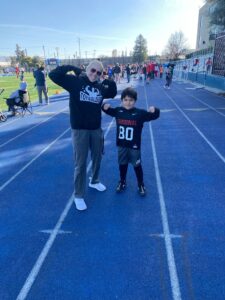
One of the most practical insights from Michelle’s episode is how she maximizes training quality in a constrained space. With only 10 feet of width and 45 yards of length, she’s developed systems that keep athletes engaged even when lines form.
Her secret? Give kids roles.
“With my resistance training, I have a T Apex that I use in my space. That means there’s constantly a line while kids go,” Michelle explains. “So I try to have kids go twice in a row, then I try to wait at least three minutes before they go again. They’ll have to go to the iPad to run the tablet. They’ll be the one that cheers them on. They hold the box because today’s a heavy day.”
For littles (ages 6-10), she caps sessions at 8 athletes. For middle school and high school kids, she can manage 10-12 with two lines running constantly. The key is minimizing wait time and maximizing engagement: get in, get out, get in, get out.
This approach aligns with what other successful trainers have shared about group training economics—running efficient groups isn’t just about revenue, it’s about keeping athletes focused and developing through competition and peer interaction.
Transparent Policies That Protect Your Business
One of the hardest parts of running a private training business? Enforcing cancellation policies without damaging client relationships.
Michelle struggled with this early on. Last-minute cancellations meant lost income with no way to fill the slot—a pain point Jeff Schmidt also experienced before switching to automated systems. But confronting parents about charges felt uncomfortable—especially when she needed every client she could get.
Her solution combines youth sports coaching software with transparency. Using CoachIQ’s automated reminders, she sends morning texts to families with sessions that day: “Hey, reminder. If you need to switch or cancel your session, just do it before four hours. Otherwise, you forfeit that credit.”
“I’m not over here trying to sneak in like, ‘Hey, if you can’t get it within four hours, sorry,'” Michelle says. “It’s more like, here’s the transparency. This is the policy. I’m going to be a grown-up about this.”
The first time someone misses the window? She gives them grace. After that, she enforces the policy consistently. Clients respect the clarity, and Michelle protects her income without awkward conversations.
The Impact That Keeps You Going
Beyond the business systems, Michelle shared a story that captures why coaches do this work in the first place.
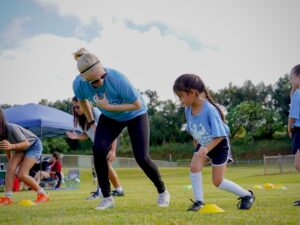
One of her former athletes, Austin Ajiake, now plays linebacker for the Indianapolis Colts. Michelle was his strength and conditioning teacher in high school—technically she couldn’t train the football team directly, but she had him in her weight training class.
From Weight Room to NFL: Michelle’s former student Austin Ajiake is now on the Colts’ 53-man roster—proof that the relationships coaches build matter far beyond the training floor.
“Training aside, I always put training aside because X’s and O’s, that’s not where the impact I make,” Michelle reflects. “What matters to me is like, do coaches respect you? Are you coachable? Do you have a great attitude? Can you bounce back from adversity?”
She took Austin on immersion trips to build houses in Tijuana, helped him through injury rehab during his senior year, and watched him navigate financial challenges as a teenager. Now she sees him doing service at hospitals and planning camps back in the Bay Area.
For coaches building their own businesses, Michelle’s story is a reminder: the systems you implement—automated session booking, seamless payment collection, your own coaching website—aren’t just about efficiency. They’re about creating the time and mental space to make the kind of impact that lasts decades.
What’s Next for Toy Soldier Training
Michelle’s 2026 goals include finding a dedicated facility, hiring her first staff member, and building out a video homework portal so athletes can continue their development between sessions. She’s also committed to giving back—sponsoring youth athletes in Hawaii who can’t afford registration fees for their sports.
Ready to eliminate scheduling chaos and focus on what matters—training athletes? See how CoachIQ’s scheduling and client management tools can give you hours back every week.
Connect with Michelle:
- Instagram: @toysoldiertraining
- Website: www.toysoldiertraining.com
- Email: toysoldiertraining@gmail.com
