

Justin Razooky trains over 200 players every week in a 2,000-square-foot gym using basketball training software that actually works. He’s hosted NBA players, top high school prospects, and trained alongside Jimmy Butler. The space is tight, sessions run back-to-back with zero buffer time, and somehow it all flows seamlessly.
The secret isn’t just great coaching—it’s the basketball training software running behind the scenes. In this episode of the CoachIQ Podcast, Justin breaks down how he and his brother Ryan built The Hoop House into a three-facility operation, why they ditched spreadsheets for real software, and the business lessons every trainer needs to hear.
In This Episode
- Why Justin went from Google spreadsheets to CoachIQ (and never looked back)
- The credit-based model that increased revenue and client flexibility
- How to design high-energy sessions in small spaces
- The real difference between trainers who grind and trainers who build businesses
- Why chasing pros might be the worst move for your training career
From Spreadsheet Chaos to Real Basketball Training Software
Before CoachIQ, The Hoop House ran on a Google spreadsheet. Every new client meant manually adding names, tracking which days they’d committed to, and color-coding whether payments came through.
“We had a kid, say the kid’s name is Daniel, we go ‘All right Daniel, you want to come twice a week? Mondays, Wednesdays? Cool, you’re going to come Mondays and Wednesdays,'” Justin explains. “So imagine just having to write down all these kids manually. We’re highlighting them if they’re not going to come, bolding their names. Highlighting them in red if they weren’t showing up, green if their payment went through.”
At 200 players a week, that system becomes pure chaos. Trainers become secretaries instead of coaches—the same breaking point Jeff Schmidt hit when he was spending 5-6 hours every Sunday managing schedules via text.
The Hoop House tried building their own software. The payment processing didn’t align with their needs. Then they found CoachIQ.
“CoachIQ is probably the greatest app that I’ve personally used as far as organization,” Justin says. “Having a branded app that integrates—we have the Hoop House app on iPhone and Android—is the greatest lifesaver.”
The switch enabled them to move from a rigid session model to a credit-based scheduling system where clients purchase credits and book whenever availability opens up. Similar to how Pilates studios operate—flexible for the client, more efficient for the business. It’s the same shift toward optimizing revenue per hour that’s helping trainers across the industry maximize their earning potential.
“We figured out that we were able to actually make more with less, just maximizing,” Justin says. “We’ve had so many players just come back to The Hoop House because of our new schedule, because it was more flexible.”
Designing Basketball Training Sessions in Small Spaces
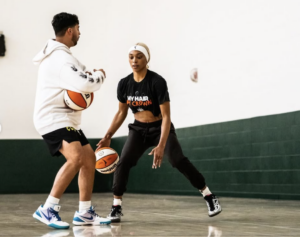
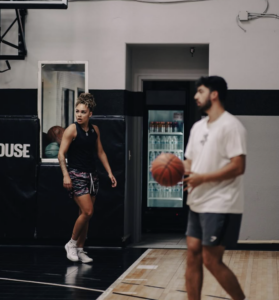
The Hoop House isn’t a massive facility. The actual gym space is just under 2,000 square feet with three hoops. But Justin runs 12 to 14 kids at a time, sessions stacked hour after hour with no breaks between.
The key is knowing every player who walks through the door.
“I already know all their skill sets and what they need to work on,” Justin explains. “In five seconds, I’m like, ‘Okay, this kid needs to work on this. This kid really needs a shot. He’s a little too weak for that finish.’ I’m already orchestrating in my head.”
For younger players (12 and under), Justin prioritizes conditioning and competition. Layup races. Push-ups for the losing team. High energy.
“A lot of parents like to see that their kid is walking out of those sessions like, ‘That was a good workout,'” he says. “At the end of the day, it is a workout. It is a sport. You got to keep it fun.”
For older players, the approach shifts to detail and game-realistic scenarios. Partner drills. Situational training. Defense on the hip, contact finishes, help-side reads. No standing in lines.
“We hate lines,” Justin says. “Kids start throwing the ball at each other. They start messing around. They lose motivation. So we get these kids going and their hour really feels like 20 minutes just because it’s going by so fast.”
Their scheduling reflects this intensity. Sessions don’t run 3:00 to 4:00, then 4:30 to 5:30. It’s 3:00 to 4:00, 4:00 to 5:00, 5:00 to 6:00—minute increments with no wasted time.
That precision requires systems. Without basketball training software that offers centralized client tracking, running that tight an operation would be impossible.
The Difference Between Basketball Trainers and Business Owners
Justin started training at 15 when his brother Ryan sent him to Mexico to run a camp by himself. No Spanish. Forty kids. Local news showed up.
“I was really thrown in the fire,” Justin laughs. “After that, I kind of told my mom and my brother, ‘I think I can do something here.'”
That sink-or-swim start taught him something most trainers miss: understanding what your time is worth.
“There’s a lot of Instagram trainers who are only in it for the pros,” Justin says. “They trade so much of their time and don’t get a dollar just to kind of get in certain rooms. They’re just a cone or a rebounder. They’re not progressing.”
A real business requires different thinking—what Russell Reeder calls the foundation of the $100K blueprint.
“Get the sixth man on the AAU team, get him to be a starter. Now get him to be the best player,” Justin explains. “Every other parent has seen you develop this kid and now you potentially have 12 to 15 more clients.”
The room for growth with middle school players is enormous. A kid might just need to make consistent left-hand layups or develop a reliable mid-range shot. Three to five sessions later, they’re noticeably better. Parents see the results. Referrals follow.
That approach—combined with the right basketball training software and a professional website that converts visitors into clients—built The Hoop House to three facilities and a nine-person staff without relying on professional athletes.
Why Chasing Pros Can Hurt Your Training Business
Justin has worked with pros. He spent a summer training with Jimmy Butler. High-level high school players like Mikey Williams have come through The Hoop House.
But his advice to young trainers is clear: don’t build your business around professional players.
“Pros require more work. They want the prime time. They want the 4:30 PM and they might not show up till 6:00,” Justin says. “Now you just wasted an hour and a half of your life.”
The economics rarely make sense unless you’re at the very top of the industry.
“We have three facilities, nine staff members, and we’re able to take care of all that without a single professional basketball player,” Justin explains—a multi-location playbook similar to what Coleman Ayers built with By Any Means Basketball. “The bread and butter cannot be the pros unless obviously you are Drew Hanlen or DJ Sackmann.”
Even elite trainers diversify. DJ Sackmann has an app. The most successful trainers build systems that don’t depend on any single client showing up.
Justin’s formula: treat it like a real business. Clock in, clock out. Keep your Instagram professional—it’s your resume. And focus on developing the players who actually need you.

The Right Basketball Training Software Changes Everything
The Hoop House didn’t scale to three locations by working harder. They scaled by building systems—the same approach that helped Tyler Leclerc grow from a seven-day grind to two facilities.
Automated payment processing eliminated awkward conversations about money. The credit-based model meant clients could book flexibly without constant back-and-forth. In-app messaging that keeps parent texts off your personal phone gave Justin his life back.
“They’re able to text in the app and we can reach back out in the app,” Justin says. “That is an amazing tool.”
Without those systems, trainers become full-time administrators. The basketball takes a backseat to logistics.
“Obviously you could just work all day long,” Justin acknowledges. “But at the end of the day, this isn’t really a career that provides a 401k and medical benefits. You’re on your own and you got to figure it out.”
Figuring it out means recognizing when manual processes break. It means investing in basketball training software that actually understands how training businesses work—not generic scheduling tools built for nail salons and yoga studios.
The Bottom Line
Justin Razooky started with nothing but basketball knowledge and a willingness to get thrown in the fire. Today, The Hoop House operates three facilities, serves hundreds of players, and runs with the precision of a well-oiled machine.
The difference between trainers who burn out and trainers who scale comes down to systems. Basketball training software that handles scheduling, payments, and communication.
“Find your why and the reason why you’re doing it,” Justin says. “If you’re doing it because you love the game, then do it the right way. It’ll pay respect back to you.”

Ready to stop managing spreadsheets and start scaling your training business? See how CoachIQ can help →
Connect with Justin Razooky:
Instagram: @jrazooky
The Hoop House: @the_hoop_house
