Podcast
How Justin Alliman runs a youth basketball program for ages 2 through the pros
Justin Alliman has an NBA championship ring and a gym full of two-year-olds. Everybody in there gets held to the same bar.
Most coaches asking how to run a youth basketball program start with age groups and drill menus. Justin started somewhere else. He set a rule about how everyone in the building gets treated, then built the programs to fit it.
He runs Dream Chaserzzz Basketball out of Woodbridge, Ontario, in the Greater Toronto Area. Along the way he coached as an assistant with the Raptors 905, and he has a ring from Toronto's 2019 title run.
Justin sat down with host Brandon Evans on the CoachIQ Podcast to walk through the gym he built, how he keeps it affordable, and why the 10-year-olds get treated like pros.
Who is Justin Alliman?
Justin started training in 2012 and incorporated Dream Chaserzzz in 2013. His first athlete was his cousin.
We started in LA Fitness. No facility, no nothing, just both of us with a dream in different ways.
The cousin went on to play NCAA ball. One athlete became two, then three, then a staff.
Before any of that, Justin was building basketball businesses on the other side of the world. He opened five facilities in India and worked with NBA Asia launching NBA schools in other countries. The way he got in is worth stealing. He found a woman online doing the job he wanted, and Instagram had no DMs yet, so he scrolled ten posts down and left his email in her comments asking her to mentor him. She said yes, and she still is.
His route into the Raptors organization was almost as casual. At a summer league game, Masai Ujiri asked him a fair question:
He was like, man, what do you do because I've seen you everywhere, but I don't know who you are.
He applied for an assistant coach job with the Raptors 905 and got it. His first assignment was Chris Boucher, plus a three-month summer program he wrote before the season started. Then Toronto won the championship and he missed the parade, because he'd booked his honeymoon during the Finals.
How do you run a youth basketball program for ages 2 through the pros?
Ask him and he doesn't start with age groups. He starts with what else is in the building.
Training begins at age two, which happened because his daughter was two and wanted to be wherever he was. From there it runs up to pro athletes, with group, team, and private training and the rep academy in between.
Then there's the rest: a fitness gym upstairs, chiro therapy, physiotherapy, massage therapists, film study, and a mentorship program for coaches building their own businesses. He calls it a full, well-rounded ecosystem.
We have everything in there that someone would need to be successful on and off the basketball court.
Why treat a 10-year-old like a pro?
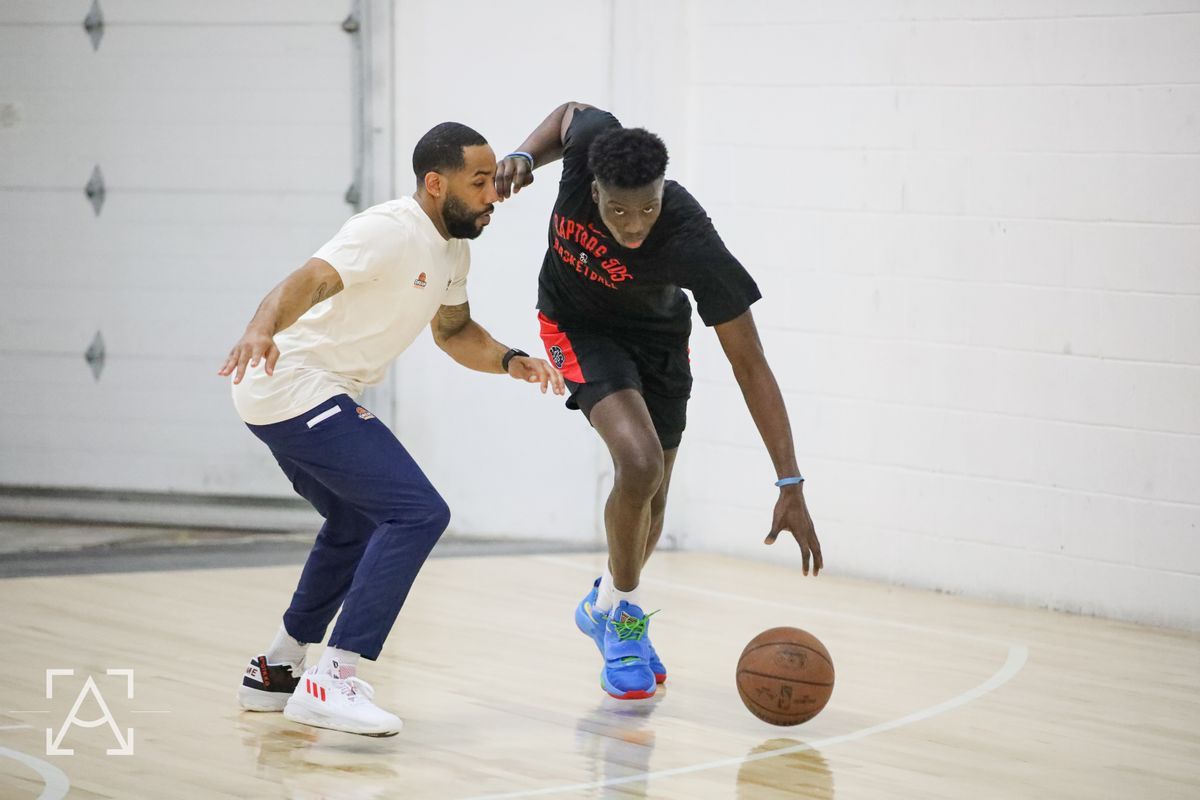
His motto is on the website and his Instagram: train and treat everybody like a pro. What makes it more than a slogan is the schedule. He books pro athletes directly before or after the youth groups so the kids can watch them work.
Because I want them to see like, look guys, we are doing some of the same drills that you guys are doing.
The gap has nothing to do with the drill.
The difference is their intensity. The difference is their intentionality.
The only thing he changes is how he says it. A pro gets one version, a 12-year-old gets another, and the bar doesn't move.
How do you keep elite training affordable?
He prices it around the kid who can't pay, because he was that kid.
Nine kids in the house, single parent. Basketball was the cheap sport. All it needed was a ball and an outdoor court. He didn't make a team until his final year of high school. Then he got a job to pay for rep basketball and had to quit the team, because he couldn't carry both.
I wanted everybody to feel that they can get professional style training or pro treatment, regardless of their financial barriers.
The part most operators leave out of how to run a youth basketball program is what happens to the family that can't afford it. Justin runs free programming and low-cost programs alongside the paid ones. All he asks back is respect for the facility, the game, their parents, and themselves.
He's seen the other extreme. In India, and at camps in Africa and around Asia, he ran full hour-long sessions for kids with no shoes and no ball.
We use rocks to draw the lines on the court.
How do you hire coaches and match them to athletes?
Almost every coach on his staff is somebody he played with, played against, or trained himself. He knows their work ethic before they ever run a session. Then he puts each one where they can be great, instead of asking everyone to be great at everything.
Placing athletes runs on a completely different rule. His coaches can all teach shooting and ball handling, so skill isn't the tiebreaker.
To me, there's no best trainer. It's who's the best trainer for my son or daughter.
A shy kid gets an outgoing trainer. He pairs on personality, because relatability turns into trust, and trust is what makes a kid willing to fail in front of somebody. The staffing half of this gets a fuller treatment in how to hire coaches for a sports training business.
What gets an athlete into the high performance program?
An application, then an interview with the parents in the room.
The program is invite-only. Sessions run three hours, with meal prep, massage therapists, chiropractors, doctors, mentorship, and film study on site.
The parents sit in for a specific reason:
Because the kids gonna say one thing and the parents gonna say another thing and then before long we're all on different pages.
What he's filtering for isn't talent. It's whether the athlete wants to be there:
You may not be good right now, but you don't suck. Your effort could suck.
He'll push a player whose mechanics need work. He won't spend a session motivating somebody who doesn't want to be there. In a group, that spreads faster than anything he can teach.
How did he get out of the admin seat?
He was on a different platform before this one. He won't name it, but he'll describe the feeling:
I just felt like it was still kind of chaotic. It was still kind of hard to manage.
The piece that changed his week was Credits. A parent buys a program, gets a set number of Credits, and from then on the booking is their job.
It just takes one or two steps away from me having to double check something when it already shows up there.
He's the first to say he's barely scratched the surface. His online content isn't live yet, and he hasn't pushed the Inbox as far as he wants. That's changing now that he's hired an admin. It's the quiet operations answer to how to run a youth basketball program at his size. He runs it on athlete self-booking and Credits and packages, so he stops being the last step in everybody's schedule.
What's next for Dream Chaserzzz
The online academy is the priority, so athletes anywhere get the same quality without him in the room. There's also an ebook coming, short on purpose, quick pointers for coaches just starting out. Everything else he'll only call expansion.
I always like to believe if you master one thing, the next step is to master something else.
The bottom line
Justin's answer to how to run a youth basketball program is one standard applied to everybody who walks in, from a two-year-old to a pro. The other half is a price structure that doesn't lock out the family who can't afford it. The rest is operations: hire out of your circle, pair athletes to coaches by personality, gate the elite program on effort instead of talent, and hand the booking back to the families. More on the facility side in how to run a basketball training academy.
He also wrote a book about the years before any of this worked. Before My Glory won the People's Choice Award for Author of the Year, and his reason for writing it is the whole argument:
I got sick and tired of people saying, you are just so lucky.
Follow Justin at @justinalliman and Dream Chaserzzz at @dream.chaserzzz on Instagram, or at dreamchaserzzz.ca.
Running youth groups, an elite program, and pro sessions out of one system? Book a CoachIQ demo and see how it fits your program.
Full Episode Transcript
Read the full transcript
The following is a lightly edited transcript of the episode above.
Brandon Evans: Welcome back to the CoachIQ podcast. I am your host, Brandon Evans, a fellow training business and facility owner. Today we have Justin Alliman, the founder of Dream Chaserzzz basketball out of the greater Toronto area. Justin's resume is incredible. He has been an assistant coach with the Raptors G League team. He's got an NBA championship ring from the 2019 Toronto Raptors. He's worked with NBA players like Pascal Siakam, WNBA players like Kia Nurse and Natalie Achonwa. And he's been running Dream Chaserzzz since 2013, he also wrote a book and runs a mentorship program teaching other trainers how to build their businesses. Justin, welcome to the show.
Justin Alliman: Thank you for having me. It's my first time on the show and I've watched other episodes and you guys are doing some great stuff.
Brandon Evans: Yeah, yeah, we're excited to have you on there. There's a lot to get into here. So let's let's get straight into it. So I have to start with the Toronto Raptors. You are assistant coach with the Raptors G League team. You're a part of the organization when they won the championship in 2019. Walk me through how you got to that position and what that experience was like.
Justin Alliman: Well shoot, that's how I got to that position I would say, to be honest, it was through my brand, Dream Chaserzzz. I was traveling around the world and helping different, you know, different private owners of basketball programs, showing them how to open up basketball programs from the ground up. So I was working in India at the time where I opened five basketball facilities. And the NBA was just coming into different countries and opening those NBA schools that everybody sees now. And they actually saw me there and they offered me a job while I was there. I couldn't take the job while I was there because I was already under contract. Fast forward a year later, my contract was, well, I actually canceled it. And the NBA called me back and they said, are you good? Are you free? Are you good to go? I said, So started working with the NBA. So I was working with NBA Asia. Again, helping them open all these schools and helping them continue to grow the brand globally. And while I did that, I came back. I was going to the All-Star Games here in North America. And then I went to a summer league game and there were some Raptors representatives there. And I happened to know some of them just through working with different organizations in Canada. And one of the guys was like, hey. It was Masai actually, not one of the guys, it Masai Ujiri. He was like, man, what do you do because I've seen you everywhere, but I don't know who you are. And everybody that I know in this Toronto organization seems to know who you are. And then one of the guys was like, that's Justin Alliman. He works at the NBA, you know, abroad. And he said, well, why don't you work with us? And I said, I would love to work with you guys if a job is offered, then, you know, Toronto is right in my backyard. So. They had this new position going on with the Raptors 905 for assistant coaches and I applied for that. They told me to apply and then of course I had to go through the whole application process, interviews and all the things that you need to do in order to get that job. And I did it and from what they told me I crushed it. And next thing I knew I was hired as one of the assistant coaches. And for me, I didn't stop there. kind of. For me personally, whenever I have a role given to me, I try to exceed that role as much as possible, right? Because I believe if you're not trying to push to go beyond what you're actually doing, you're not trying to grow. So when the opportunity came up and they're always asking, is there anybody who can come up and kind of train some of the guys from the Toronto Raptors or help out or rebound or do any of these things? I was always the first person to put my hand up or offer my support to one to go up and do that. eventually some of the guys up there started to trust me as a familiar face. They just wanted me around and that's how I ended up getting to train a lot of those guys, right? I was also in shape because I just finished playing as well. So I was able to obviously not guard these guys and shut them down because they're still NBA guys. But know their plays, go through their sets with them and show them kind of stuff in a different way, right? So that's how it came about.
Brandon Evans: Yeah. you Yeah, that's really, really cool. I want to touch back to the beginning portion of that. How do you even get involved with building basketball businesses in India, in other countries like that? Is it through social media or how?
Justin Alliman: funny you say that but back then there really wasn't like social I guess social media was just starting Facebook and everything was around but this was like 2015 Instagram was there but it was more like the picture version of Instagram you know like when you only post the pictures there was no DMs there was no none of this other stuff so funny enough I had even though it was only pictures I saw somebody online doing something that I wanted to do
Brandon Evans: Yeah.
Justin Alliman: And so what I did was I wrote to her. And I couldn't DM her, so I had to write my email on her actual post. I scrolled down like 10 posts, wrote my email and said, hey, I love what you're doing. Do you think that you could walk me through the process of how you got started? I'd love for you to be my mentor. And she still happens to be my mentor to this day. I actually just saw her a couple of days ago in Tennessee when I was there. So she helped me. She walked me through the process of how she got to be overseas, running programming and doing all these things. And I took that and I... kind of expanded on the things that she did and I just kind of skyrocketed from there.
Brandon Evans: That's so cool. I have personally, like I told you before we got on, I'm a basketball guy, I have a facility. And I've personally found a passion as well for helping other coaches. Because I think my impact, I've learned how to do this. And... If I can help other coaches do the same thing like that feels very morally fulfilling for me because you see, mean, you see it too, the impact that it has on the kids that are actually in your gym. So being able to recreate that is something super special and it means a lot. Um, you've done it on a massive scale. that's, that's very, very cool. Um, so yeah, talking about the Raptors when they, when they won in 2019, what was that moment like for you? Were you super? involved. What was that like?
Justin Alliman: It was a surreal moment, you know, because one, to be honest, I never, we, me getting that job with the Raptors 905, I never thought that the Raptors are going to win that year. You know what I mean? And it's no shade on them. We were always, we were, we were a good team. You know, we were, we, for the last couple of years, we were first in the East a couple of times. We were first in our division. had
Brandon Evans: Yeah. I didn't think they were gonna win.
Justin Alliman: great success, but we just couldn't get over the hum, you know what I mean? And then we had this blockbuster trade that comes out of nowhere that no one thought was even possible. And Kawhi Leonard comes, right? And then that changes the landscape of everything, you know? So going into that season, wasn't a thought in my mind, like we're going to win the championship. was so much of that. wasn't a thought that, you know, like I actually got married in 2019 and my honeymoon was booked during the NBA finals. Right. So After we won it, we went to Jamaica for our honeymoon. And after we won that championship, we had the parade. I didn't even get to go because I was on my honeymoon. So that's how much of it wasn't even a thought in my mind. So everybody was calling me. All the coaches were like, hey, Justin, the bus is about to take off. You're the only coach who's not here. We're all waiting for you. And I was like, bro, I'm in Jamaica. They're like, no way. I said, yeah, remember I? I just got married a week ago, you know? And so they had to do the parade without me. And people were on FaceTime and everything. But obviously, I still got my ring and all the other stuff. But yeah, it was just a surreal type of moment, know? Something that you don't dream about. Like some of my favorite players to ever play the game, I think, they don't have a ring. But I somehow got it. And I didn't play in the NBA. You know what mean? Obviously, I contributed because.
Brandon Evans: Yeah.
Justin Alliman: Our G League team that year, we had a lot of guys who crossed over and from being like two way players to getting signed fully with the Raptors and being a real player that made a big difference in how the Raptors performed in those playoffs. Like Chris Boucher, Jordan Loyd, we had a lot of guys who were going up and doing work there, And as you see Chris Boucher, he ended up being one of the last Raptors on that 2019 team who was still with the Raptors up until... I last year or this year.
Brandon Evans: Yeah, that's very cool.
Justin Alliman: He was actually the guy that I was assigned to train when I first got the job in the G League. He was the guy that they were like, this is your guy. You need to make sure he's good.
Brandon Evans: So they assign you, was he the only person that you got assigned or is that how it works?
Justin Alliman: not necessarily. Like, I still had a responsibility to look after most of the people, but I had to develop like, I had to develop a three-month summer program for him before the season started that he could follow. Yeah.
Brandon Evans: Okay. Okay. Got it.
Justin Alliman: Because he was a guy that they knew that they were gonna need when they get deep into the playoffs. Just people getting injured and having available bodies ready to go. So he was somebody that they were like, let's keep a good eye on him and do this. And for good reason, he's still in the NBA now,
Brandon Evans: That was a good call. That's a very cool story. You definitely can't reschedule that honeymoon though. Have to go on that honeymoon. So this is a question that I like to, I love asking people that have have. pro experience in any way, and you obviously have had it at the highest level, and trained youth, what is different to you about training that NBA player or pro versus training the 12 year old at your academy, besides the obvious skill gap?
Justin Alliman: Well, I'll just say it like this. To me personally, I have a motto. If you go on my website or if you go on my Instagram or anything like this, it says Dream Chaserzzz, train and treat it like pros. So I like to train and treat everybody like a pro. Obviously, if they're three years old, because we do start that young, it's going to be different. But majority of our kids who are 10, 11, 12, and moving up, we like to treat them the same way. And I oftentimes. have some of our pro players train right before them or either right after. So it gives the kids an opportunity to see them and how they work and how they move and their attention to detail and how they treat their training session. Because I want them to see like, look guys, we are doing some of the same drills that you guys are doing. The is their intensity. The difference is their intentionality. The difference is how much they're focused and how much they're paying attention and how much they're taking from me and I'm giving to them. Like, I'm gonna give you everything I got even if you're 10 years old or you're an NBA or a WNBA player, but what are you gonna give back when you hear that information or knowledge that I'm doing? How are you gonna take what I'm giving you and transform it onto something on the court, right? So I wouldn't say the detail is different. I think the... specific language could be different, right? I could talk to a pro in a different way than I could talk to a youth player because they may not understand the language. You know what I mean?
Brandon Evans: Yeah, I think that's such a unique perspective. I talk to basketball people all the time, just like you do. And we hold a very similar perspective when it comes to that. At our gym, we have a couple of pro guys that are here and they train in the off season and I do the same thing. I try to bunch them together with our younger kids because we do the same stuff. Like as far as the workout structure, it's the same stuff. Like obviously, like you said, if there's super young kids, it's different, but we hold them to the same standard. Right. So I think that's just such a and powerful perspective that I don't hear a ton.
Justin Alliman: Yeah.
Brandon Evans: It's just so to see a kid I get I just always put myself in the shoes of a kid if I see if I'm 10 years old and I walk into my training session and I see a pro before me doing the exact same thing that we're about to do or that we've done before I'm like it just changes everything right It's such a big thing so I love that you said that because I'm under the same same impression same perspective so
Justin Alliman: Exactly.
Brandon Evans: Let's go back to 2013, we've talked about Dream Chaserzzz a lot. You started that with very specific mission, helping underdogs who didn't have opportunity due to financial restrictions. Where did that come from?
Justin Alliman: Well, that came from my own childhood. I believe that I've always been an underdog my entire life. Maybe people don't see it now because they see that I've had some type of success, however you want to measure that. But personally, I didn't come from a background of having finances readily available that were able to be allocated for me to play basketball or any other sport, right? So. You know, in my household, we had those nine kids, single parent, you know what mean? So basketball, at least back then, was a cheap sport. If somebody that you know has a basketball and there's an outdoor court, you can all play, right? No matter what shoes you come there with, no matter, you know, if you don't own a basketball, as long as they're there, they have the basketball, everybody can play, right? I it's not like hockey where you need equipment or football, you all these different things. It's just we're friends or not. We just come together at the playground You have a ball, we're going to play, we're going to do what we do, right? So I didn't want that to be a barrier for anybody who wants to train with myself or my team, right? I wanted everybody to make sure, not make sure, but I wanted everybody to feel that they can get professional style training or pro treatment, regardless of their financial barriers, right? So I do offer a lot of free programming to... to try to navigate those things and or other programs that are just, you know, very low cost so that everybody has the opportunity to get the style of training that they want. And then the only thing I say is like, look, we're going to give you these things, but we just act that you respect. you know, our facility, respect the game and respect your parents and yourself, right? Because again, these are opportunities that, you know, not everybody gets, regardless of how cheap it is or how expensive it might be, you are here now and you're given this opportunity and we want you to take full advantage of it, Because at any given time, there's always going to be a kid out there who still can't afford it and who would give whatever it takes to get in your position, right? And I've seen that and I've witnessed it myself. do traveling all over the world and seeing kids that just don't have anything at all. Like when I lived in India or, you know, did camps in Africa or whatever place in Asia, you know, I'm training kids, they don't have no shoes. They don't have no basketball. I've done sessions, full sessions for an hour with kids, no shoes, no basketball, no nothing. We use rocks to draw the lines on the court. and we use an imaginary ball, but there's things I can still teach them, right? And they were just grateful to be in the presence of somebody who knows how to teach basketball, right? So that's how that started, just from myself not being able to afford it and not being able to, at any point in my life throughout my youth, be able to have any training or even be on a team. I was on no teams. until my final year of high school when I had to get myself a job and then once I got the job I had to pay for my rep basketball and then I had to quit because I couldn't do both, right? So that's, I wanted people to live what I had to go through.
Brandon Evans: Yeah, that's... Yeah, I love that. Now that something that something that I think is so important is giving back like you're doing and taking yourself and putting yourself in whether you grew up like that or whether you travel to India or Asia and train kids and work with kids is exposing yourself to. that environment of just lack of resources. Because I mean, running a basketball business and everything, if you're never exposed to that, it's hard to even picture what that's like, you know? So. Like something something my program tries to do we partner with a nonprofit in town and we will do seasonal leagues and Just you know camps and stuff here and there and we try to fundraise as much as we can with just local businesses and make them either free or Extremely discounted as much as we can. So I think that's so important for of course, I mean we have a rent here I have trainers I have to pay and everything so we have to charge but Be there's ways to give back Right. There's ways to give back and there's ways to package what you do charge in a way that's fair in a way that's fair and gives kids opportunities to where if that is their only basketball, they can take the absolute utmost advantage of it. Like our gym, have memberships and
Justin Alliman: Yeah, always. Yeah. Yep.
Brandon Evans: It's unlimited at our gym, so I'm like, you can live here. We have kids that come in and they just stay here for the whole evening. They just get dropped off at school and get picked up at night. There's ways to make it work for kids that need it 100%. It's not just simply a transactional thing, so love that. So you've been doing this for 11 years now, or not 11. You said, it started, started. My math is not good. 2013, so it's 13. Yep.
Justin Alliman: See. We started, so I actually started in 2012, but we didn't incorporate until 2013.
Brandon Evans: Okay, 14. Okay, so walk me through what Dream Chaserzzz looks like today. What's your facility like, the programs, teams? What is it all like today?
Justin Alliman: Today it looks like a... Today it looks like a full basketball ecosystem. The reason I say that is because we have training that starts as young as two years old. I started that because my daughter was two at the time and she wanted to be around me. And what better way if I'm already at the gym to get her in there and tired, right? But she loved the game, I think. So starts as young as two and goes all the way up to. professional athletes, right? So that's one portion of it. We also have group trainings. We also have team training. We also have like our rep academy. We also have our fitness gym upstairs. It's just a full, well-rounded ecosystem where we have chiro therapy, physiotherapy, massage therapists, fitness enthusiasts upstairs. got film study. We have everything in there that someone would need to be successful on and off the basketball court, especially now because we included the mentorship programs and all that in there. Before that, was just strictly basketball. And now it's grown into, like you said, like a home for kids to come in there and feel like this is a place that I can grow in every facet of basketball and as a So that's what it looks like now in 2026.
Brandon Evans: And what did it look like when it started?
Justin Alliman: What it looked like when it started, to me, it looked like everything, right? Because it was something that I needed when I was younger. But basically, it was just training. I started off with one kid, which was my cousin. But he was a dedicated hooper who wanted to make it far, and he did. He ended up playing NCAA. But he trusted me with his journey. We started in LA Fitness. No facility, no nothing, just both of us with a dream in different ways.
Brandon Evans: Yep.
Justin Alliman: through myself and him, we ended up growing from one kid to two to three and then getting other trainers and creating this movement which is what ultimately started the brand, right? Which is called Dream Chaserzzz. So yeah, that's how we started.
Brandon Evans: Yeah. Yeah, it's very cool. want to dive into a little bit of what I noticed when I was preparing for the episode. You have an elite high performance program that's application based and invite only. How do you decide who gets in? What is that process like? What makes somebody able to be in that program in your eyes?
Justin Alliman: I don't know when this interview is about to go out, but we didn't even launch it yet. So this is to be the thing that tells everybody we got it. But it don't matter anyways, we're going to launch in like a week or so or less. But really, it's just about the dedication. doesn't really have to, obviously you have to have a certain level of skill because you want everybody in there to be able to compete and feel like they're getting something out of it.
Brandon Evans: you It's not gonna be for a little while, don't worry. Okay, yeah.
Justin Alliman: You know the old saying, iron sharpens iron, right? But at any league in the world, nobody's gonna be, not everybody's gonna be at the same skill anyways, right? That's what makes the beauty of basketball. Everybody's good at something, right? But yeah, so it starts with an application process. If you decide that, you you look at the dates and these work for you and you you want to commit to what we have going on, then you would apply. And from there, we would have an interview. with you and your parents because the kids gonna say one thing and the parents gonna say another thing and then before long we're all on different pages right we want to make sure that everybody's on the same page and that this is something that is actually going to benefit you and going to benefit us because this is a program that you know It's three hours every single time we do it. We have meal prep, got massage therapists, we got chiropractors, we got doctors and everything on site. We have a little mentorship, we have film study, we have all these things. And I think that those things are beneficial if the player or athlete is very focused and obsessed with getting better, right? Because that's the kind of... That's kind of attention to detail that we're going to give you. So you want to make sure that you're into it, you're locked in, you're of somebody or of some, you're of someone who's going to benefit from that by being that sort of athlete.
Brandon Evans: Yeah, that's a very cool program. So you mentioned you have other coaches working with you. How do you find those coaches and how do you maintain that quality when you're not the one running every session?
Justin Alliman: Yep. Well, I think you have to find the good in everyone. And everyone has. And when I say this, don't mean the good intention in their heart. Obviously that too. But I mean, I think that everybody's a star if you put them in the right role. Everybody can be great at something if they're given the right opportunity where they can shine. And so there's different coaches for everything. If I'm looking to do a ball handling clinic or something like this, I got to make sure that the guy that that I'm putting for that is set up for success. know his skill level and I know his pedigree. I know he brings to the table and I know that that's something he could manage. But mainly the coaches that I've had, believe it or not, are people that I've grown up with. So I've either played ball with them, played against them, or as of recent, as I'm getting to little bit more younger coaches now. These are some of the players that I've coached before and now also want to give back and come back and get jobs and work and give back to the youth and stuff like this. So again, it's me finding out, OK, I know this kid because I coached him or I used to train him. I know what he's good at. know his work ethic. I know where he can thrive and then try to help them and guide them and steer them in that direction to be successful on this side of the basketball.
Brandon Evans: Yeah, that's something I've personally experienced and a lot of other coaches experience is they find their coaches from more or less in their circle, whether it be their friends or like you said, played with them, played against them, coached coached against them. It's all in the circle because one, you can bring them on, you know, you can trust them because you've grown up with them or you've been around the scene in the city with them for however long. So that's, I think it just speaks to the importance of maintaining and keeping your circle of people because you never know when those people might want to join on with you and help start to give back to the kids. So is that how you position your private trainings? I noticed you offered that on your site. Do you position like if you know the kid and you have a certain coach that is maybe more or less a special specialty in ball handling or whatever? Is that how you place a kid with a trainer or how does that work?
Justin Alliman: So for that it's a little bit different because I believe like all the coaches I have they can teach everything they can teach all those things they can all teach shooting they can all teach ball handling they can all teach whatever it is that you're looking at right but the way that I place the athletes with coaches is by personality right I think relatability is a big thing As you see, like people always say, who's the best trainer or who's the best this or that? And to me, there's no best trainer. It's who's the best trainer for my son or daughter, right? If I know that this kid needs somebody who's he might be shy. So he might need somebody a little bit more outgoing to bring that out of him. Then I'm going to put him with a trainer that I know is like that. You know what I mean? Because that's what the parent wants to get out of this child. And that's what they're looking to get out of it more, obviously more than just basketball. They need other things that go with it. So I try to pair them like that. and see how that works because again, like I said, it's so much more than just teaching them drills. It's building their confidence. It's creating memories with these kids. It's being there and being able to talk and relate to these kids, right? So relatability has more to do with it than just can he teach them how to dribble.
Brandon Evans: Yeah. Yeah, yeah, and that relatability is something I preach a lot to the parents is it ultimately leads to trust from the kid, right? Which once the kid trusts the trainer, whether it be in a private or a group setting. It opens them up. It allows them to feel comfortable failing or struggling with something and allows them to push themselves and ultimately that will lead to them growing as a person, basketball player and everything else included. that ultimately leading back to trust is the biggest thing in my opinion personally. So I want to talk about your book. You're the first coach there that I've had on that has written a book. So it's called Before My Glory, right? And did that one a People's Choice Award for author of the year? did? So let's talk about it. What's it about? Why did you write it?
Justin Alliman: Yes. Well, you know what? To be honest, this book was something that I didn't plan on writing. I was traveling a lot throughout my earlier years. I'm not old now, but back in that time, 10 years ago, I traveling a lot. And I just thought to myself, I'm like, you know what? It's going to feel pretty good that if I could look back 30, 40 years from now and see that I have a little journal about all these places I've been and things I was doing.
Brandon Evans: Yeah.
Justin Alliman: December 13th, 2010 or something like this, you know what I mean? So I started journaling things and then somebody once told me, they were like, you know, have you ever thought about writing a book? And I was like, nah, I haven't really. No, so that thought was always in my head. But then also like it really started to form because once I started traveling a lot and doing the things I was doing, like getting scholarships and maybe, and then starting coaching and traveling, everyone was like. man, you're so lucky that you get to travel the world. You're so lucky that you got the scholarship. You're so lucky that you got this. You're so lucky this and that. And I'm like, man, you don't even understand that none of this stuff has come from luck. It's all come from hard work, dedication, me betting on myself, me believing in myself, me being there for myself when nobody else was there to help and just, you know. praying and believing and doing all these things that I've been doing behind closed doors, you know, in the darkness. And it's all just coming to light now. So I got sick and tired of people saying, you are just so lucky. So I said, listen, you think I'm successful now, but to me, I'm nowhere near what I think I can be. let me talk. But since you think that I'm successful, let me talk about or let you guys know about. before my glory, right? Before I became this person who is coaching with the G League or won this ring with the Raptors or traveled the world and working with the NBA and doing all these things. Let's talk about before that and what led to these things, right? And that's why I called it before my glory. Glory was in quotes because I think that everybody has a glory story, right? We all have something in us that we're proud of. And to some people that could be...
Brandon Evans: Yeah.
Justin Alliman: at the highest thing could be winning a Grammy or winning the Oscar or whatever. But to other people like myself, to me, I'm just a regular guy. It could have been making my high school team, you know, getting a scholarship, having my daughter, whatever your glory stories, we all got one, right? But I just wanted to let people know that it wasn't luck. It wasn't I didn't slip and fall into any of this stuff. It was a lot of long nights and a lot of struggles, a lot of pain, a lot of things people didn't see. Yeah, that's how it came about.
Brandon Evans: Yeah. Has the book opened any doors for you or how has it impacted your personal brand and Dream Chaserzzz, if at all?
Justin Alliman: Yeah, most definitely has. You know, I don't use the book, and I probably should, but I don't use the book as a selling point to, you know, to get kids or athletes or anybody into my gym. But when people do come to my gym and they start to get to know me, you know, they might do a session with me or start reading about who the founder of Dream Chaserzzz and they see that I have a book and they purchase the book. I don't tell them they purchase the book and they read it and they're so like. Baffled or like surprised or amazed at the things that they you know They seen that I've been through my journey and for them Now it's like okay. This is somebody that I could see leading my son or daughter her own adversity because he's somebody who's dealt with it. Right? It's written right here and look where he is. Right? Like for me, I'm not somebody who's supposed to be in a position that I've been able to get into. I didn't have any role model to show me how to run a business, to put me into the doors with these people for the NBA or any NBA team or anybody that I've been able to do. Like I spoke into the federal government in Canada. No one... was able to walk me through any of these processes, you know, and based on my past, if you're somebody who's read my book, you would think that there's no way that this guy is in the rooms with these people. You know what I mean? Like it shouldn't happen, but it has happened, right? And no one can take that away from me.
Brandon Evans: Absolutely, 100%. So we talked a little bit about why you teach other basketball trainers, coaches to help build their basketball business. So say, for example, you start working with somebody. What are some of the biggest mistakes that you commonly see that people make when they're trying to build their business up?
Justin Alliman: Well I would say like whenever you build a business or build anything I think that you should start building it based on integrity right on morals on values and things like that not just thinking about like how much money I can make right because the money especially in this business as you know can fluctuate right one month it could be this amount the next month it could be this amount right
Brandon Evans: Yeah, tell me about it.
Justin Alliman: The good ones know how to keep it consistent though, right? And you'll learn that over time if you stick with it. But I just think that the way that it becomes consistent is if you built it based on integrity, morals, ethics, and your values, right? If you don't have any of those things and you're just thinking about the money aspect, yeah, like I said, you're gonna make a little money here and there, but it's not gonna last, Because people aren't buying necessarily into... program there's so many basketball programs they're buying into you to what your belief is to what you stand for right and if they start to see that those things aren't showing in your own work or how you carry yourself that slowly they're gonna fade away right and soon word spreads you know that this guy is in the high character guy he's not the person that we thought we wanted to lead our son into you know the next chapter of his life and and any of those things right so I think starting on that, but also learning business and understanding people and how to fulfill their needs, right? You have to understand like what problem is your business solving, right? My for me and for you in this basketball business, I think that my problem is solving that, you know, there's kids out there who don't understand the game, who don't have. But personally for me, who can't afford to play the game or can't afford to train, right? So me serving these underserved youth or people who are underdogs, I wanted to solve that problem, right? And because I continue to stand on that, that's why my businesses continue to succeed and continues to elevate.
Brandon Evans: percent that that first point you made I think is so important and that's what I tell all of my new trainers that come on I have a staff of six right now I believe and every time they come on I'm like Everything you do people are watching so Even I'm like even us when we were on board and you because it usually takes about two or three months before we hire somebody Like we watch everything you do everything you post how you interact with people how you interact with the kids the parents everything like Every and I have some high school kids some high high character high school kids that have trained with me for You three or four years and I have them trim our middle schoolers and that's like the first thing I say is parents kids notice every little thing you do here on the basketball court when you're playing because the kids will go watch you play and they're going to love to watch you play. So you're you have to morally be up here at a high level. So that's extremely important, 100%. So you've been doing this for, like we said, about 16, 17 years. That's longer than the most trainers have been in the game, way longer than me. What has changed in the training industry since you started?
Justin Alliman: Well, firstly, there's a lot more trainers than there used to be. know, so back when I started, wasn't like a, it wasn't a common thing. You know, there was maybe one or two guys that I can even think of off the top of my, off the top of my head. But let's say even like the last five years, this training game has exploded, you know, since COVID. So, you know, every time you open Instagram, there's a new trainer and I'm not mad. think it's a good thing because that just means the love of the game has grown to a certain point where, you know, there's more kids wanting to play. So there's more demand and obviously you're to get more trainers and yada, yada, yada. But that's mainly the thing I see that there's definitely more trainers and definitely more people wanting to play basketball now. So the influence is there and we just got to make sure that the people who are doing, you know, these training sessions. again, themselves accountable, holding themselves to a standard. For me personally, like I take it serious. This is something I've been doing for like, like you said, for a long time now. I don't want anybody to come into my gym or to be at one of my training sessions who don't understand that I come with a certain standard, right? So to me, like, there's no kid out there who's not, who, who. sucks, quote unquote, sucks, right? You may not be good right now, but you don't suck. Your effort could suck, right? And that for me determines whether or not you're somebody who was holding the standard that I have for myself or for the program that I run. You know, missing every year you come to my session, you miss every single shot today. I'm not mad at you. If you were trying, you know, if you're trying your best to make sure you make these shots, they just didn't fall. That's basketball. Steph Curry goes one for 10 and then the next day he's 10 for 12. You know, but he was trying every single time he shot. But if you're one of those kids who come into the gym, you know, you're moping around, you miss the shot. takes you 30 seconds to go get your ball. You're walking back to the line. Water break is like four minutes extra. I'm like, all right, now not you don't suck, but your effort sucks and it's showing. Right. So to me, it's like, you probably don't want to be here. Right? And I'm not mad if you don't want to be here, but then just don't be here. Because now it's me wasting my time having to come over to you and talk to you over and over, trying to motivate you for something that you say you love or your parents says you love. And it's clear that you don't, you know, because it wasn't, if it was, if it was a different scenario or if you did love it, I wouldn't have to. continuously push you or force you to do these things. And as a coach, yeah, you're gonna push players. But that's when we see the potential to do more, It wasn't their effort, we just wanna make sure your mechanics or whatever else it is, is going well,
Brandon Evans: Yeah, and that's so important, especially if we do a lot of group training in my gym. And I mean, I've seen it firsthand. If there's if there's kids that don't want to be there again, it's fine if you don't want to be there. Just just don't be there, like you said. But it rubs off on the other kids whether they think it does or not. Right. The other kids may be fully intent on trying as hard as they can and they're fully focused. But that that even that one person who is doing all the things that you listed It drags down the whole energy of the group and then on the flip side if you have a group of four to six kids and all of them are on it all of them are are really focused like that is Top-tier energy like that is what we want every workout to be Yes 100 % like
Justin Alliman: That's the thing. That's the best thing. I have a great day when that happens. I'm excited. I'm fired up when I get that, you know? And I'm coming to every session like that anyways, because I'm assuming that's what the kids or the athletes are going to be bringing to me, right? But then when it's not, it's like, all right, you can sit down over there and you'll join us next session or whatever it is.
Brandon Evans: Yeah. Yeah. Yeah, yeah, and it's just tough. Personally, I'm trying to do our business. We're trying to attract more kids like that. So we've made our onboarding process very similar to your... elite higher lower program. regardless of what level of kid you are, like we're going to talk to you and the parent for 30 to 45 minutes before you even come in for your trial session for one of our groups, because we just, we just can't allow that energy in the gym, right? Cause it just, it just drags everything down. It, whether everybody thinks it is or not, like
Justin Alliman: Yeah, it's contagious. Yeah.
Brandon Evans: So you have all of these programs, Two year olds, you have all of these different things going on. How do you manage the operations side of it? I know your site is on CoachIQ. Walk me through how you use CoachIQ and how that blends in with your business.
Justin Alliman: Well, I was using something different before that, which I'm not going to mention. No need. But for me, I just felt like it was still kind of chaotic. It was still kind of hard to manage. But for me, getting to use CoachIQ made things a lot easier for me in terms of just the operation side, like you said. I love the fact that there's a credit system there. So you purchase the program and it gives you a certain amount of credits and now it kind of leaves the onus into the athlete or the parent's hand to like, gotta book yourself in to be a part of that class and make sure that you're doing it on time where you can actually get into the class. like, just takes one or two steps away from me having to double check something when it already shows up there, right? So I think it made it really easy in that aspect by adding that credit system that I wasn't used to before. But also there's so many things that I think are very valuable that I haven't even really used it. think like for me when it comes to CoachIQ, I'm only scratching the surface because I haven't done my online stuff yet with it. haven't fully used the... the inbox messages to the full extent that I can in terms of like showing like our players of the day and all these things yet, right? But thankfully now I got a good admin on who she'll be taking that on. So, you know, that's the reason why I haven't been able to do that because there's just a lot of different stuff I do and that admin is just a full-time job in itself, right? So like you want to do it anyways, so.
Brandon Evans: Thanks It is. Do you use CoachIQ for pretty much everything as far as dream chasers goes? Because I know some reason I ask is some coaches use the different pieces of it. I use it for everything.
Justin Alliman: Not everything yet, but like I said, before I was doing the admin stuff, so it was hard for me to sit down and get the time to do everything, which shout out to Russ, but he probably heard me messing him a lot for things that the answer's already there.
Brandon Evans: Uh-huh.
Justin Alliman: Now I'm trying to implement where I could use CoachIQ for everything, right? And obviously there are ways to do that. having more time on my hands, I'll be able to utilize that more.
Brandon Evans: Okay. this. Yeah, so last couple questions here for you. We'll wrap this up. What is next for you personally?
Justin Alliman: Next for me, I can't say it all, but I will say some. Now that I'm starting to get a little bit more time on my hands because I have my admin and I have more of my coaches in place and all that kind of stuff, I do want to launch my online academy. So, know, like we explained that coach kids all over the world or athletes all over the world, but not having me there in person. I'll still be able to be there in person or give them the training sessions through my online academy stuff. So I really want to focus on that and finish that up during this year so that I get to reach even more people that still want to train with myself or Dream Chaserzzz team. Give them that same quality that giving people in my gym, but just online. And then I do have a couple of things that I can't mention yet on the pipeline. But obviously one of them that I'll mention is just an ebook for coaches looking to get in the game here and start their own business and stuff like that. So just something small that they could flick through really quickly and get quick pointers on how to move and things that they should look out for early on. And then, yeah.
Brandon Evans: Yeah. And then what is next for aside from the online training, what is next for dream chasers? If anything, you've already got a lot going on there.
Justin Alliman: There is some next, you know, expansion. I always like to believe if you master one thing, the next step is to master something else, right? And I believe that ultimately expansion is also, was always something that I wanted to do because I believe that, you know, there's dream chasers all over the world and why not be able to help as many people as I can, right? So. That's what I'll say, just expansion, no, no. there.
Brandon Evans: Don't want to give away all the secrets. So. Awesome, awesome, awesome. Justin, thank you for coming on. Talking about your journey was great from starting Dream Chaserzzz in 2013 to NBA G League assistant coach to championship ring to work with NBA and WNBA players to writing a book to teaching other trainers. There's so much here for people to learn from, regardless of what stage they're at or what sport they're in or if they're even a training business owner, just business in general and basketball person in general. Where can people find Dream Chaserzzz in you?
Justin Alliman: You can go on my Instagram, which is Justin Alliman on Instagram. That's my personal one. Hopefully you put it in somewhere they can see it. And then my basketball one, which is dream.chaserzzz. The other one got hacked. So make sure it's dream.chaserzzz because the hacked one is still up there, but it's definitely hasn't been active since 2014. That's how long they do it. It's been hacked for 11 years. Yeah, dream.chaserzzz, you can see all the basketball content, stuff like that. My Justin Alliman one is more so the personal one. It kind of shows you more of like how to build that basketball ecosystem and stuff of that nature.
Brandon Evans: Mmm. Yeah, well everybody go follow Justin and Dream Chaserzzz. Like he said, we'll put the links on screen in the description here. If you're in the GTA and you're looking for basketball training, Justin and his team are clearly the real deal. They know what's going on. Justin, thank you for coming on. It was awesome having you.
Justin Alliman: Thank you for having me, appreciate you.
