Podcast
How to move your sports facility business model from lessons to memberships
Miko Rodriguez grew up training at Elite Baseball and Softball and now owns part of it. Here is how the 50,000 square foot facility stopped selling hourly lessons, and what the membership looks like now.
Most training facilities are still built on the private lesson, and most owners know the ceiling that comes with it. Changing your sports facility business model from hourly lessons to monthly memberships is how one baseball and softball facility in West Michigan got past it.
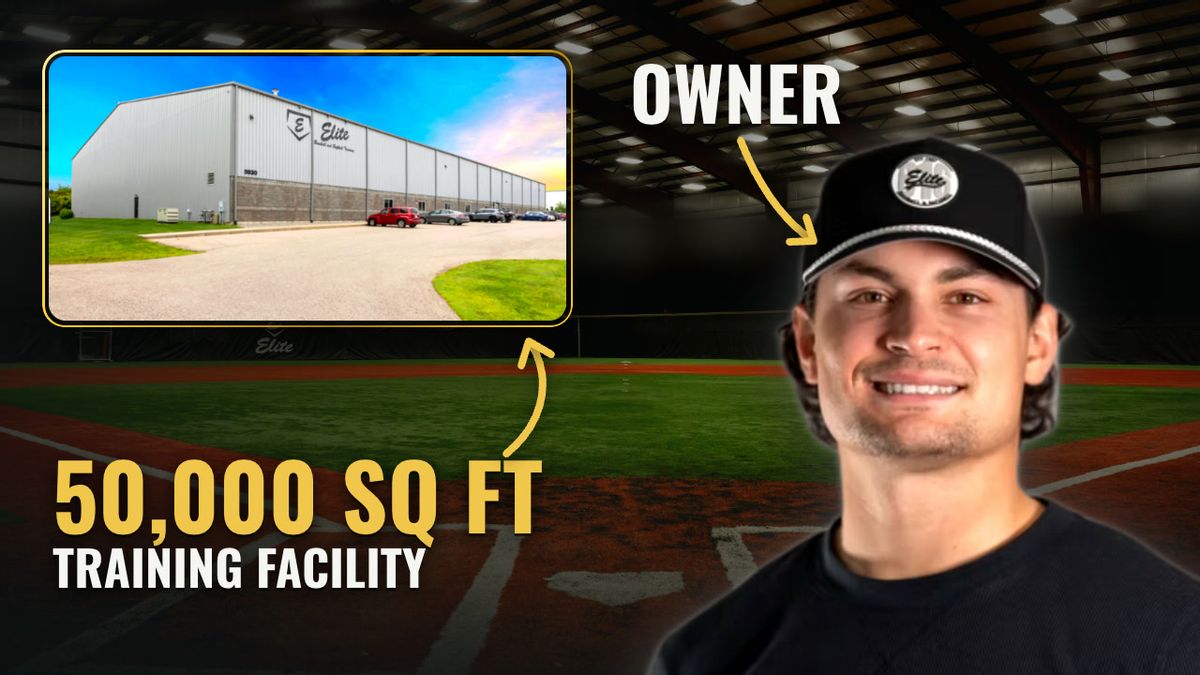
Miko Rodriguez started training at Elite Baseball and Softball in Grand Rapids as an 11U player. He went on to play Division I baseball at Texas A&M before transferring to USC, and when his family bought the business around COVID he came back to it. At 26 he is a part owner of a 50,000 square foot facility. He sat down with Russell Reeder to walk through what the old lesson model was really costing Elite, and what the membership that replaced it looks like.
Why did the lesson pack model stop working?
Because the facility was paying out almost everything it took in.
When Miko's family took over, Elite still ran the way it had for 25 years. Lessons sold in packs of 8, 10 and 15. Team players got the packs 10 or 15 percent cheaper. Then came spring break sales, Christmas sales and Black Friday sales on top. The trainers were 1099 contractors paid by the hour.
Add that up and there is nothing left. "At that point, we're pretty much like paying out our trainers the amount that we're bringing in for lessons," he says. "And so Elite's really not bringing home anything."
The trainers were not really part of the place either. "You're a trainer here, go to your assigned lesson and just do the next one after that." Every discount came straight out of a margin that was already thin.
What does a membership-based sports facility business model look like?
A monthly membership that puts credits into the player's account, with credits that expire at the end of the month.
"The cool idea is that, you know, your credits would expire at the end of the month, so it keeps you accountable to showing up multiple times per week," Miko says. Families schedule their times out in advance.
There are two levels. Two days a week, or unlimited, which right now means Monday through Saturday. Every visit is the same two hour block: the first hour is hitting or pitching in a small group, and the second hour is always strength and conditioning built for baseball and softball, which means rotational work, arm care and general athleticism.
The family is not buying a lesson anymore. They are buying a month of development, and the expiring credit is what makes them use it. Our breakdown of running a training academy on unlimited memberships shows the same structure in basketball.
What goes into the membership besides training?
Everything a serious high school player would otherwise buy from four other places.
Miko's own path is the reason. As a player he hit at Elite for an hour after school, went to a gym to figure out lifting on his own, watched YouTube for recruiting advice, and his family paid "thousands of dollars a year to pretty much teach you how to write emails and communicate with coaches." Nobody was working on the mental side or on nutrition.
So Elite value stacks the membership. Members get a recruiting consultation once a month with the on-staff director of recruiting, who works from a list of college coaches Elite has already sent players to. Nutrition tracking and mental performance training are included as well.
"If I'm a baseball or softball athlete right now as a high schooler and I wanna make it to the next level, Elite is here for you to give you everything that you need."
How do small group ratios change the math?
They put more athletes through the same hour without cutting the attention each one gets.
"Our ratio on the hitting side is three to one, pitching is four to one, fielding is five to one," Miko says. "So we're working with way more athletes over the course of a single day, and they're getting a better service."
A lesson model cannot do that. One trainer, one kid, one hour, and the building only has so many hours. "It's not something where you can actually scale and continue to add people to your training program, because there's only a certain amount of hours in the day, there's only a certain amount of space within the facility, to where you're gonna reach your ceiling."
If you want to run the numbers on your own floor, our guide to group training vs individual sessions walks through the economics.
Don't kids get less attention in a group?
This is the pushback Miko hears most from families who are new to Elite. Wouldn't my kid get more individualized attention in a one-on-one lesson?
His answer is the assessment. The membership lets Elite run a full assessment system and reevaluate each athlete after a period of training, and every athlete gets a specific development plan built from that. "Just because we're not the only one with the kid in the cage for that amount of time doesn't mean they're not getting individualized attention."
The lesson, in his view, is the thing that is not individualized. He calls it "a feedback tool," not a player development tool. "It's just like in and out, onto the next kid. And you're only working with the kid so often over the course of an off season, to where it's hard to really gain ground and actually make them better."
Russell made the same point from the athlete's side: in a good group of four or five kids, a player competes against the others and learns from the coaching points aimed at them.
Who should a facility build its offer around?
One type of athlete, chosen on purpose.
For its first few years under the new owners, Elite served everyone, from the rec ball player who had never trained to the high level athlete. That had to change. "What type of athlete, what type of family do we want in our building?" Miko says was the question the last year was spent answering.
Elite picked the high level athlete. When you are trying to maximize efficiency, he says, you have to narrow down on one of those athlete types, and the membership, the recruiting consults and the strength program are all built for that player.
How do you compete when other facilities undercut your price?
By being the one place that does the whole job.
What Miko sees in West Michigan is "a lot of people trying to undercut our prices by offering like a less than service." One facility runs travel teams with no player development. Another does development with no teams. Families save a couple hundred dollars a year, still get a travel team, and lose the training.
His argument to those parents is that the games alone do not develop a player. "It actually takes the whole development system behind that, throughout the course of the off season, to build up the player to actually have the skill sets needed to make it to the next level."
Russell put the owner's version of it plainly. A facility that does only teams, or only development, or only recruiting, leaves room for someone to come in and beat it at that one thing. A facility doing all of it is much harder to compete with.
When is it time to switch your facility's software?
When it breaks in the middle of the busy season.
That was the trigger for Elite. "There would be just like blackouts, and it would prevent our ability to communicate with our clients and for them to be able to schedule within the facility." The tools it did have were not going to improve how the facility ran day to day.
The other cost was time. Miko built the landing pages and the website himself, separately from the client portal, because none of it synced. Every ad, every section, every picture and link came through the office. Now the website, leads, ads, landing pages and member portal all run on CoachIQ. If you are weighing the same move, our guide to sports facility management software covers what to look for.
Why does the sports facility business model matter more than the building?
Because the building is the easy part to see.
Elite already had the space and the trainers. What it did not have was a model that turned them into a business. Miko calls the work since "closing the gap between what we have been capable of doing, which is the crazy amount of space, the really high quality trainers," and the systems that make sure "we're actually running a business and not just a sports facility."
A lot of owners, he says, get stuck in the trap of running the day to day without ever optimizing the business underneath it. If that is you, our guide to how to run a sports training facility is a good place to start.
Where to follow Miko
Miko Rodriguez is a part owner of Elite Baseball and Softball Training, a 50,000 square foot facility in Grand Rapids, Michigan.
Instagram: @elitebbsb
Website: elitebaseballandsoftball.com
If you are ready to move your facility from lessons to memberships and want the credits, scheduling and payments running in one place, book a free demo with CoachIQ. CoachIQ is trusted by 750+ sports coaches and training facilities.
Full Episode Transcript
Read the full transcript
The following is a lightly edited transcript of the episode above.
Russell Reeder: I'm here with Miko with Elite Baseball and Softball Training out in Michigan. Has a 50,000 square foot baseball softball facility. Really excited to have him on the podcast and learn a little bit more. Why don't you kick us off, tell us a little bit about your background and how you got started with your business.
Miko Rodriguez: Yeah, so a little bit about me, you know, played Division I baseball, and even before that was a Grand Rapids kid, which is where we're based out of. So went through the whole high school recruiting process, trained on my own, which is where I think my love for the training process and player development comes from, is just my own experience having come up as a player through that process. And then earned the opportunity to go play Division I baseball at Texas A&M, which is a big switch from Grand Rapids, Michigan. And from there, transferred out to USC here in Southern California and graduated in 2022, and ever since then kind of just plugged right into Elite. The background on kind of how that got started for myself: having been a player through that organization itself from like 11U to when I graduated high school, from being on their teams and training, I got to really just fall in love with the place, and that's where I'd be every single day after school. And so there was an opportunity within my family to purchase the organization and the business right around COVID. So we took that opportunity, and slowly I've been kind of just ingraining myself in the business as a whole, and to this point I'm a part owner in the entire business.
Russell Reeder: So that's probably where I would want to start. This is one of the more interesting stories. I love how you're 26, right?
Miko Rodriguez: Correct. Yep.
Russell Reeder: So you grew up in the whole development system at the facility you own now, and then play college sports, and now you're running a very successful business. So you probably have one of the best views in the current times.
Miko Rodriguez: Yeah.
Russell Reeder: So starting there, what was your development experience? And how are you developing athletes now, today, based on what you went through yourself?
Miko Rodriguez: Right, and I can speak from, obviously, experience having gone through it. I think the development system that's offered at Elite, prior to us coming in and switching some things around, was the lowest hanging fruit, just from speaking from experience. Because similar to a lot of different organizations all across the country, it was kind of one-on-one private lessons, where that is like a feedback tool. It's not necessarily a player development tool where you're gonna get meaningful time in with high level quality instruction from trainers. Definitely not enough to where it's actually gonna make a difference over the course of the off season. So for me, it was a once a week lesson, and it was participating on travel teams, and the rest of it was filled in on daily, you know, hitting sessions with my dad and myself, just trying to figure it out on our own. And so what we're doing now is kind of based off the idea of like what I wish I would have had as an athlete.
Russell Reeder: Cool.
Miko Rodriguez: Right. And so what that is, is a multiple time per week training development program, where you're in small groups split up between your age level, to where we're able to have multiple touch points with athletes as a training staff, where it's more than just feedback. And, you know, it's actually like the day-to-day drills that you're doing, seeing every single swing you're taking in the cage or a throw on the mound or whatever it may be. And then incorporating strength and conditioning as well, to really just make a more well-rounded training program for these guys.
Russell Reeder: Yeah, I've seen that a lot at CoachIQ too. Like a lot of the best facilities, they kind of create like an all-in-one experience for the parent.
Miko Rodriguez: Yeah.
Russell Reeder: So I know every single sport's different, and we have a lot of different sports on the platform, but talk about the all-in-one experience that you've created at your facility and how you've kind of navigated that. Because I know teams are very different than training, right? But yeah, just talk a little bit about that too. Strength and conditioning even is a whole nother, you know, mechanism of that. But yeah, how do you organize all of that?
Miko Rodriguez: Right. Yeah, I'll start with the training program, which kind of syncing that between our teams and our training program is very interesting when you sit back and think about it. But I'll start with kind of training there. And so what we do is a monthly reoccurring membership, which, you know, adds credits to your player's account. You're able to schedule your times out in advance. And the cool idea is that, you know, your credits would expire at the end of the month, so it keeps you accountable to showing up multiple times per week. We have different levels of membership. So we have two days a week, and then we have unlimited, which right now is Monday through Saturday. So if you're an unlimited kid, it's six days a week of training. Each time you come in, it's a two hour training block. So the first hour you're in small groups working on either hitting or pitching, based on what you signed up for. Then the second hour of those sessions is always gonna be strength and conditioning, which is more specific to baseball and softball, which is gonna be a lot of like rotational work, a lot of arm care stuff, and obviously your general athleticism building. And so also within those two hour sessions, we also value stack the membership, to where you get recruiting consultations once a month with our on staff director of recruiting. The whole goal there is to pretty much set you up with whatever you need as far as education, as far as game planning, and then also advocating on behalf of the athlete with our list of coaches that we're communicating with and have previously sent players to them as well. So we also do nutrition tracking and also mental performance training as well.
Russell Reeder: Cool, very cool. So yeah, I mean, the thing that I see where that's so beneficial to parents is parents are just kind of going to try and get that in all these different vendors, essentially. And if you can bring it to them in one place, you have all the context on them, and you can even lower the unit economics for them and give them a better experience, because it's kind of all in one. So, and then as a parent, it's so much nicer. Like, I don't want to go to five different people. I want to trust one person.
Miko Rodriguez: Exactly.
Russell Reeder: Super cool.
Miko Rodriguez: And on that too is like, this whole thing comes from my personal experience too. Like I would go hit at Elite for an hour after school. I'd go to the gym after that and try to figure out my own lifting on my own. I would have to like YouTube recruiting consultations, or I think we had like an NCSA subscription or whatever it is, thousands of dollars a year to pretty much teach you how to write emails and communicate with coaches. And on top of that, I probably didn't do any training on like the mental skills side, or I didn't know anything about nutrition. So for me, it's like, okay, if I'm a baseball or softball athlete right now as a high schooler and I wanna make it to the next level, Elite is here for you to give you everything that you need.
Russell Reeder: Yeah, no, that's awesome. Really cool. Every single sport's very different as far as how it works. Walk us through how baseball and softball works as a parent. Like you're a parent, you have a kid, he loves baseball, he maybe wants to play college sports. What does that ecosystem look like? Is it year round, teams, training? What does that look like?
Miko Rodriguez: Yeah, so the pipeline to the next level, if you're serious about it, you know, you're probably signed up for a travel team, whether that's the same program that offers your player development or not. Like a lot of places just do travel ball, especially in West Michigan, in general in any of those Midwest states. You've got these big facilities, you know, you're obviously experiencing some rough weather a lot of the year, so you're indoors a lot of the time, just training, doing team practices all year round. And then once, you know, April hits, you're out there doing tournaments for the youth guys. Obviously you're playing high school sports for the high schoolers. And then all summer long, you're playing tournaments as well. And so I think what a lot of people are in the habit of doing is just relying on the team stuff, where they're just doing the travel ball experience and they're playing tournaments, playing some recruiting showcases, or going to college camps or something like that. But they're dismissing the whole idea behind player development, thinking that the games themselves are gonna be what makes the player better. But it actually takes the whole development system behind that, throughout the course of the off season, to build up the player to actually have the skill sets needed to make it to the next level.
Russell Reeder: Yeah. So I always ask coaches this too, with, you're so much more knowledgeable than a regular parent who has a kid navigating this space. If you had a kid right now, like what would you encourage them to do, or what would you sign them up for, and how would you navigate that, so they're not burnt out, so they're getting, you know, what they want to get? What would that look like? And then the last thing I would say, you know, we primarily have facility owners that are listening to this. I think so valuable to listen to this response, because this is what the parents are looking for too, right? Like if you can put yourself in the seat of the parent, that's how you can reverse engineer your offer and how to deliver the best experience possible. But would love to hear your thoughts on what you would do as a dad. What's the dream experience? I'm assuming it's very close to what you're delivering right now.
Miko Rodriguez: Yeah, and that's the whole goal behind what we are doing. I mean, you know, I talk to parents all the time. I talk to travel ball coaches. I talk to college coaches all the time. And, you know, what parents are looking for in general is to just have like an all-in-one experience, right? And so for us to be able to have teams, to be able to have a facility, to be able to get your work in within your player membership all year round, and also the player development opportunities, is really like everything that a player should be looking for if they're serious about the sport.
Russell Reeder: Yeah, I also love too, as far as your competitors go, like if I was trying to come and start a baseball softball facility in your area, it's like not possible, because you're delivering an all-in-one. Now if you were just development, or just recruiting, or just teams, you open yourself up to like, oh, someone who's really good at development kind of can come in. So I think that's another cool aspect. It's not only better for the parents, but also if you're thinking as a business owner too. Now, it's case by case, sport by sport, but in baseball, it definitely seems like this isn't the best way to set it up.
Miko Rodriguez: Yeah, and I'll say what I've seen recently within the market in my area, which is West Michigan, has been just a lot of people trying to undercut our prices by offering like a less than service. So a lot of places, they'll only account for the team opportunities, and they'll totally dismiss the player development, or it'll be the exact opposite, where it's player development with no teams, right? And so if I'm a parent in West Michigan, again, we're looking for an all-in-one experience, and I feel like Elite is probably the only opportunity to get that. And I think there was a big rush to save a couple hundred bucks over the course of the year to go to a less expensive place and still play on a travel team and wear some cool uniforms and stuff like that. But at the end of the day, if your goal is to provide opportunities for your athlete, help them get to the next level, then not accounting for the player development side is going to definitely prevent you from giving them the best opportunity in that area.
Russell Reeder: I would argue too, if you're a parent and you have a son or daughter who, you know, you don't know if they're gonna play college sports, it's still the best environment for them to be in, right? Like your guys's staff, your guys's resources, to be around kids who might get college scholarships. That's the confidence they are looking for too. But just a great experience all around. So really cool there. Let's dive into the business side of things now. So we were talking a little bit about it before the podcast. So Miko runs his entire business on CoachIQ. It's been awesome working with him and helping him grow his business. What have you learned on the business side of things? So you were a part of it when you weren't an owner, and now you're part of it as an owner. What have you changed, and what did you learn on the business side of things as far as structuring your offer, all that good stuff?
Miko Rodriguez: You know, this goes back all the way to kind of how I grew up knowing and understanding what Elite was. And Elite itself has been an organization since 1997 or something like that. And then for me, it was from 11U to 18U. And I think for the first two or three years of me being in the position I'm at with Elite, we didn't change much on the business structure, like on our offer and our service and things like that. It was very similar to like how the previous 25 years were operating. So at a certain point, you know, when you're experiencing, you know, hardships within business, like something has to change, and you gotta be able to elevate your service, elevate your offer, to narrow down like who you wanna service. And so for us, that's been the process the past year, is figuring out like, who are we best working with? What type of athlete, what type of family do we want in our building? And before that, we were servicing everyone. Like we were working with the rec ball player who had never trained before, and we were, you know, servicing the higher level athlete too. And when you look at it from a standpoint of like, okay, when we're trying to maximize efficiency within the business, we have to narrow down on one of those athlete types, right? And that's going to be high level for us. And then from the just service offer, we previously were in like a lesson package operation, right? Like we had 1099 contractors on the floor. We had people who were just getting paid by the hour to run lessons. And not only is that not as good a service for the athlete, and we've kind of already touched on why an all-in-one player development system is better, but as a business, our margin was super capped, and it was pretty much trading time for money, right? Versus now, within a membership system, we're working in small groups, so our ratio on the hitting side is three to one, pitching is four to one, fielding is five to one. So we're working with way more athletes over the course of a single day, and they're getting a better service. And so we're able to bring more athletes into the program, generate more revenue that way, while providing a better service.
Russell Reeder: And then it was like a catalog to parents before, so it was like, oh, you want hitting, or you want this, or you want this?
Miko Rodriguez: Yeah, so it was just like we sold lessons in packs of 8, 10, and 15, and then we would cut down like the price of the packages by like 10 or 15 percent for our team players. So we're losing margin on that. And then like spring break sales or like Christmas sales or Black Friday sales, we'd cut down margin even more. And so at that point, we're pretty much like paying out our trainers the amount that we're bringing in for lessons. And so Elite's really not bringing home anything. And even on the relationship between Elite and our trainers, totally just distant, right? They didn't fully ingrain themselves into our culture, what type of techniques or like foundations of hitting, pitching or fielding we wanted to incorporate with the athlete. It was all kind of just like, okay, you're a trainer here, go to your assigned lesson and just do the next one after that.
Russell Reeder: Very transactional.
Miko Rodriguez: Exactly.
Russell Reeder: Yeah. And then I've always seen too, on the parent side, a parent comes in and is like, I didn't play at Texas A&M or USC, or I'm not thinking about baseball 24/7. So you're asking me to come choose between this like huge menu of options. I don't know what to choose.
Miko Rodriguez: Yeah.
Russell Reeder: So not only is the membership so much better for your business operations, but also you can curate. Like, hey, I have an eval on your kid, your athlete. I can see what he needs to work on. And then, you know, here's your package on how we're gonna maximize his talent and his athleticism and all of that, rather than a parent like choosing, I think is terrible.
Miko Rodriguez: Exactly. Like we would do lesson packs, we would do camps and clinics, we would do all these different stuff. And I think one kickback I get from families who are brand new to this is, wouldn't my kid get more individualized attention if you're in a one-on-one lesson? But when you sit back and think about it, the membership allows us to do the whole assessment system, and we reevaluate after a period of time once they're actually with us training. And so from that, we're building out specific development plans for each and every athlete. And just because we're not the only one with the kid in the cage for that amount of time doesn't mean they're not getting individualized attention and things like that. So I think that's a common misconception, is that lessons are an individualized approach, which it really is not. It's just like in and out, onto the next kid. And you're only working with the kid so often over the course of an off season, to where it's hard to really gain ground and actually make them better.
Russell Reeder: Yeah, yeah, we get this all the time, like all the facilities, you know, parents saying, oh, I want one-on-ones.
Miko Rodriguez: Yeah.
Russell Reeder: I don't think it's better for the athlete.
Miko Rodriguez: No.
Russell Reeder: Especially as being a former athlete, like if I'm in a really good group of four to five kids, I'm gonna be competing against them. I'm gonna be learning from the coaching points on them. Obviously the athlete has to be deliberate and bought in, but yeah, I'm not a big believer that the one-on-one is better. It's just like perception, I feel like, from the parents.
Miko Rodriguez: Yeah, yeah, for sure. Then obviously business-wise, we touched on, you're just capped, you're trading your time for money. It's not something where you can actually scale and continue to add people to your training program, because there's only a certain amount of hours in the day, there's only a certain amount of space within the facility, to where you're gonna reach your ceiling. And at that point, what do you do?
Russell Reeder: Yeah, totally, 100 percent. So you have a cool example as far as transferring platforms too. Talk about a little bit, why were you open to changing platforms? Because I know changing platforms is a lot, right? You have a lot of families, a lot of payments, a lot of stuff. So why were you open to changing platforms, and talk about that transition a little bit?
Miko Rodriguez: Yeah, we were definitely in the market for adjusting our operating software. Just during the middle of our busy seasons, there would be just like blackouts, and it would prevent our ability to communicate with our clients and for them to be able to schedule within the facility. And so the software itself was a little bit shaky and not too reliable. I think the tools that it, you know, gave us access to, to run our business, wasn't anything that was actually gonna improve how we're doing our day-to-day operations. And so yeah, definitely we're in the market for making a switch. And so far, you know, nothing but good things to say about CoachIQ and what it's enabled us to do, from just a payment side, a scheduling side, a client management side. It's all been kind of head and shoulders beyond, you know, what we were doing before.
Russell Reeder: Yeah, we love to hear that. So yeah, one of the things, I mean, every time I'm talking to a facility owner and they're using a platform that like runs multiple different businesses, like not just sports, you kind of see it in the features and like all the stuff. But yeah, we've been finding a lot of success. Like all we work with is sports facilities, so every feature that we think about is for you guys, and that just compounds in all the little things.
Miko Rodriguez: Even at a deeper level too, it's like you guys are sports facilities, but you're also, once you onboard a business, you're specifying everything to that business. And so my build on CoachIQ won't look the same as the next baseball and softball facility, because our service is different. You make sure that there's an individualized approach to exactly how everything looks from the admin side too. So there's a lot of value there.
Russell Reeder: Yeah, that's cool. I'm glad you brought that up. We're working really hard to personalize the software exactly for you. So right now you're actually seeing a lot of people like, oh, I can go vibe code my own thing or do whatever or solve this pain doing this. I mean, we're spending a lot of time giving you guys the safety and security and the harness of what we've built, but also having the flexibility of matching your business with what you guys need. So we were talking about it before the podcast, I love how we're releasing our teams feature. You know, you run teams, that's going to show up for you exactly how you want it. And then you can render that in your player athlete app how you want it to render, and then it's just not even going to show up for other people across the United States, because they don't do that.
Miko Rodriguez: Exactly.
Russell Reeder: So like what are some of the biggest things that CoachIQ has helped you time-wise, like that you used to do, compared to how it works now?
Miko Rodriguez: Right, and so a lot of my job was to build our landing pages, build our website, and then also separately from that, manage our client portal, because they just didn't sync up. They weren't the same platform. And so previously, like I would spend all the time in the world just updating the website, and every single ad copy, every single like section within the website, every single picture, every sort of link that was on there was coming from the office at Elite, which was a headache. And definitely, even at that point, it wasn't professionally done. It wasn't as good as it could have been. It was just good enough, and it was a website to put out there, put our information out, but it wasn't optimized to actually run the business the right way.
Russell Reeder: Yeah, yeah, yeah, we've been putting a lot of time on that. We're super excited for our Copilot as well. Like the goal is, you can literally just text our Copilot or text us, and just throws up a whole new camp page, perfect to your brand, and can create new products for you, anything like that. So spending a lot of time on trying to save you guys as much time as possible. But similar to you and your facilities, like all-in-one for a parent, trying to bring that all-in-one for you guys, right? Like where it's not disjointed. It's not a different platform in the back end versus the website, so it all syncs up, right? No, so we're fired up about that.
Miko Rodriguez: And it was totally, exactly, like disjointed is the perfect word, right? And like we had an operating system, we had a different website service, and we would do social media and our ads completely separate too. Now it's all under one system, right, which is CoachIQ, to be able to manage our website, manage our leads, manage our ad copies, manage our actual ads, our landing pages, and then also our member portal and how families and clients actually can utilize Elite.
Russell Reeder: Yeah, definitely. We're pretty excited about the ads. We actually, we've kept it pretty restricted among our whole community. We wanted to like really dial in the ad service, so we started offering done-for-you Facebook ads, and, you know, it's been going really well. I'm really excited about this, because if you are a user on CoachIQ, you're using our website, you're using the back end, we can do a really phenomenal job in creating really good funnels to target the parent, and it's all connected to your website. We don't have to go use, then again, another tool to build you a really nice funnel to close parents. And then we also have all this amazing data on your business, so we can get really granular with the scripts on how to get new parents in the door. And then also too, we can cut down the cost. If you want someone else to go run your ads and manage your ads, you're paying four or five grand for some agency, whereas with us, you know, since it's all in one place, since we're invested in your business, we can cut down the unit economics. It's also kind of funny how it's the same exact thing with what you're doing for parents, right? Like you can deliver such a better experience with the all-in-one. Obviously like the balance there is, you know, you have to deliver a good experience, right? You can't just be like, hey, we're gonna just do everything. So that's why we've kind of kept it pretty reserved. We wanna make sure it's really dialed before we release anything to our community. But yeah, man, I appreciate you coming down. I appreciate you doing a podcast. We'll have to do some more of these and keep up with your business. I think our community is gonna be really interested to hear your story and how you've built such a huge facility. 50,000 square feet is one of the largest on CoachIQ, so pretty cool. And I mean, we didn't talk about your numbers, but your numbers are also one of the best too, as far as your space, how many athletes you have. So really impressed with the business that you've built.
Miko Rodriguez: Yeah, and I would say from a business standpoint, also just operating, we're closing the gap between what we have been capable of doing, which is the crazy amount of space, the really high quality trainers, but also having now the business systems to be able to make sure that it's all optimized, and we're actually running a business and not just a sports facility, which I feel like a lot of coaches get stuck in that trap of, you know, kind of just run the day to day without optimizing their actual business. So CoachIQ has done an awesome job in just helping us, you know, be on track with that, and really appreciate it.
Russell Reeder: Yeah, we'll keep it going, man.
Miko Rodriguez: Yeah.
Russell Reeder: Cool.
