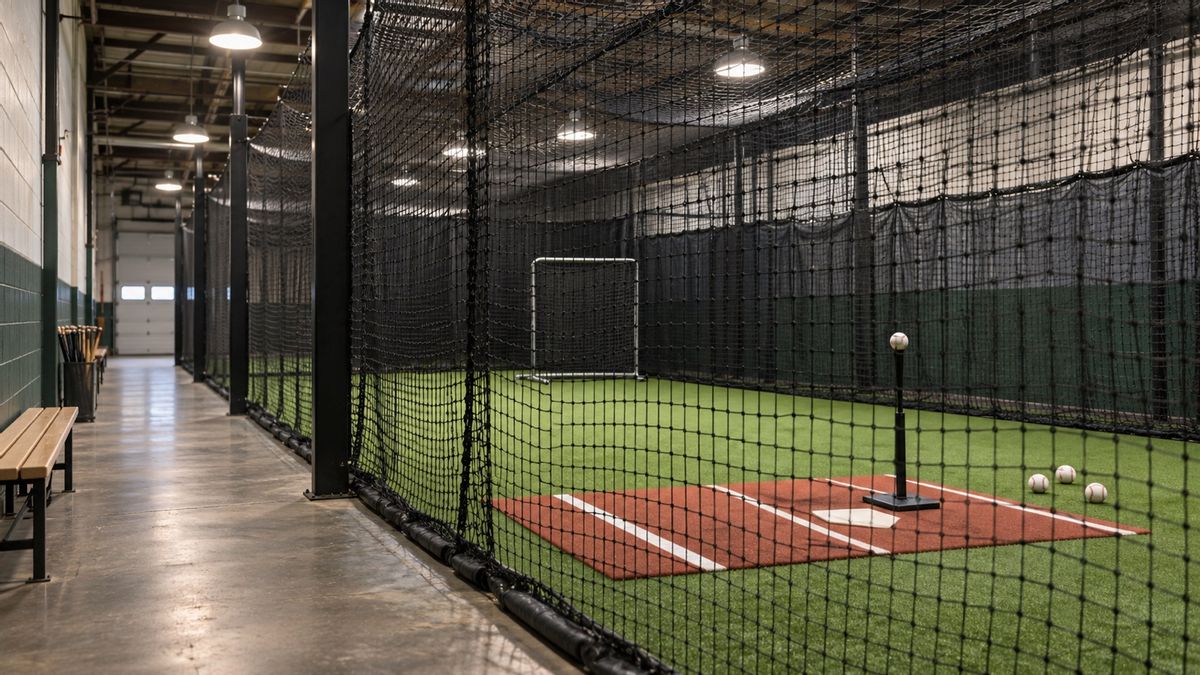
AI-generated illustration of an indoor batting cage.
Set an hourly rate that covers your costs at the number of hours you expect customers to book. Then check what a team or family would pay for a similar cage nearby. If comparable local rates sit below your break-even rate, test a different rental schedule or cost assumption before you commit to a price.
This worksheet is for indoor baseball and softball facilities that rent cages by the half hour or hour alongside lessons, team practices or other training.
Count the cage hours you can actually rent
A facility with two cages can rent two cage-hours in one clock hour if both cages are available separately. Mark the hours already reserved for lessons and teams. Block out maintenance and any reset time that prevents another booking. If a full-turf rental uses both cages, count both as unavailable for individual rentals during that block.
Start with hours customers are likely to pay for. If 300 cage-hours are available for rent each month and you expect to sell 60%, use 180 paid cage-hours in your calculation. An existing facility can start with recent booking records. If you’re opening, run a slow-month case before relying on the busier scenario.
Calculate your break-even rate
| Input | Your facility | Example |
|---|---|---|
| Monthly fixed costs rentals need to cover | Allocate a share of rent, insurance and other recurring costs. | $5,400 |
| Expected paid cage-hours per month | Multiply bookable rental hours by expected utilization. | 180 |
| Cost that rises with each paid hour | Estimate incremental labor, equipment wear and supplies. | $4.00 |
| Flat payment fee per hour | Divide the flat fee per booking by average hours per booking. | $0.30 |
| Percentage payment fee | Use your effective fee for the payment mix you expect. | 3% |
Break-even hourly rate = (allocated monthly fixed costs ÷ paid cage-hours + variable cost per paid hour + flat payment fee per paid hour) ÷ (1 − percentage payment fee).
In this fictional example, the hourly floor is $35.37, rounded up to the next cent. The rentals need to recover $30 an hour in fixed costs, $4 in variable costs and $0.30 in flat processing fees. The percentage fee comes out of the amount the customer pays, so divide $34.30 by 0.97.
If lessons and camps also contribute to fixed costs, agree on how much each activity needs to cover. Count a cost once. Add a monthly amount to fixed costs before dividing by paid hours if you want rentals to build a reserve, such as one for replacing a pitching machine.
What happens when rentals slow down?
Using the same fictional costs and 300 bookable cage-hours:
| Share of rental hours sold | Paid cage-hours | Break-even hourly rate |
|---|---|---|
| 40% | 120 | $50.83 |
| 60% | 180 | $35.37 |
| 80% | 240 | $27.63 |
At $45 an hour and 180 paid hours, this example leaves $1,683 after the modeled costs for the month. The same rate at 120 paid hours leaves a $678 shortfall. That’s why it’s worth modeling a quiet month before you discount.
Compare what local renters actually get
Write down the total that a renter would pay for the same length of booking. Check whether the price includes a pitching machine, how much space the booking reserves, and whether the rate requires a membership or team agreement. Compare hour with hour and check half-hour prices separately, since two shorter bookings can mean two payment fees and more reset time.
For example, Extra Innings Training’s published rental sheet lists a 50-foot cage at $55 for an hour and a $10 pitching machine add-on. Under that rate sheet, the hour with a machine costs $65. Use facilities in your own market to set your comparison set.
Decide which hours to discount
Start with a time your booking records show tends to sit empty. For an after-school slot that regularly sells, compare what each offer contributes after its direct costs. A rental that covers the hourly floor can still be a poor trade if it displaces a lesson with a higher contribution.
If you offer a team a recurring block, put the time, cage count and cancellation terms in writing. If you offer a half-hour rate, check what you can sell on either side of it. A half-hour rental that leaves a gap nobody books uses more of your calendar than the receipt shows.
Put your rate into the booking calendar
Before you post the price, check that customers can see what the rental includes, when they can book and how they cancel. Test a rental and a lesson that share the same cage. Make sure the second booking cannot take the same space at the same time.
For a broader buying checklist, see our sports facility management software comparison. If you’re still pricing your space and equipment, start with the baseball and softball facility planning guide.
Book a free demo to walk through how your rentals, lessons and team bookings could share a calendar.
