
Sports Facility Management Software: What Actually Works for Coach-Led Training Facilities
Guide

Best Sports Facility Software (2026): 7 Platforms Compared

Compare seven platforms for facility scheduling, rentals, payments, memberships, and the coaching work behind every booking.

By CoachIQ March 10, 2026

Article and comparison updated October 5, 2026.

Quick answer: For a coach-led training facility, CoachIQ is our recommended starting point because it connects Sessions, coach and space scheduling, payments, Credits, athlete records, and communication. Also compare Upper Hand, EZFacility, Swift, Baseline, eSoft Planner, and Mindbody against the work your facility sells: coaching, rentals, memberships, camps, or fitness classes.

Your facility may sell a private lesson, a cage rental, and a camp registration on the same afternoon. The best sports facility software needs to handle those different bookings without making the front desk piece the day together.

This guide compares seven platforms for facility owners. Start with the shortlist, check the costs and tradeoffs, then use the demo and migration exercises below to test your own operation.

Published by CoachIQ, which is included in this comparison. Recommendations reflect our assessment of workflow fit. Product and pricing sources were checked October 5, 2026. This is a review of public vendor information, not a hands-on test of every platform. Confirm plan-specific features and fees in writing.

Best sports facility software at a glance

Platform Workflow to shortlist it for Pricing and buying consideration
CoachIQ Coach-led facilities connecting Sessions, packages, memberships, athlete records, and communication Varies; monthly subscription, no annual contract. Confirm your facility's configuration in a demo.
Upper Hand Programs alongside facility resources, retail, and staff administration Start: $79/month; Grow: $199/month, paid annually. Facility/resource management is listed in Grow.
EZFacility Resource scheduling, rentals, leagues, memberships, and front-desk operations Request current pricing for your required features and locations.
Swift Sports facilities selling lessons and rentals with online booking Request current subscription, processing, and add-on pricing; we could not verify a public base price.
Baseline Facility operations with a transaction-funded entry plan Base: $0/month plus $250 setup; card processing listed at 3.9% + $2.79 per transaction.
eSoft Planner Facilities choosing modules for lessons, rentals, camps, and memberships Core starts at $39/month; price the modules your operation needs.
Mindbody Fitness and wellness classes, memberships, and consumer discovery Starts at $79 USD/month per location; confirm plan and add-on requirements.

These are starting points, not equivalent quotes. A low subscription price can exclude the resource tools, modules, or reporting you need. Processing charges also matter when families make many small purchases. Each platform's section links to the official source behind its entry.

How we compared sports facility management software

We used the same buying questions for each platform: what can a family book, what constrains availability, how is payment collected, what information stays with the athlete, and what does the owner need to administer separately?

Our recommendations favor the reader running a coach-led training facility. A rental-focused operator may weight space utilization and league administration more heavily. An academy may put more weight on athlete history, packages, and communication between coaches. A larger academy can still have a coaching-first workflow; headcount alone does not decide the fit.

Public feature lists do not prove every combination works on every plan. Where a detail is unclear, we identify a demo question instead of marking the feature absent. Ask vendors to demonstrate waivers, staff permissions, reporting, and migration with the same sample data.

The seven platforms: strengths and what to verify

1. CoachIQ: Our pick for coach-led training facilities

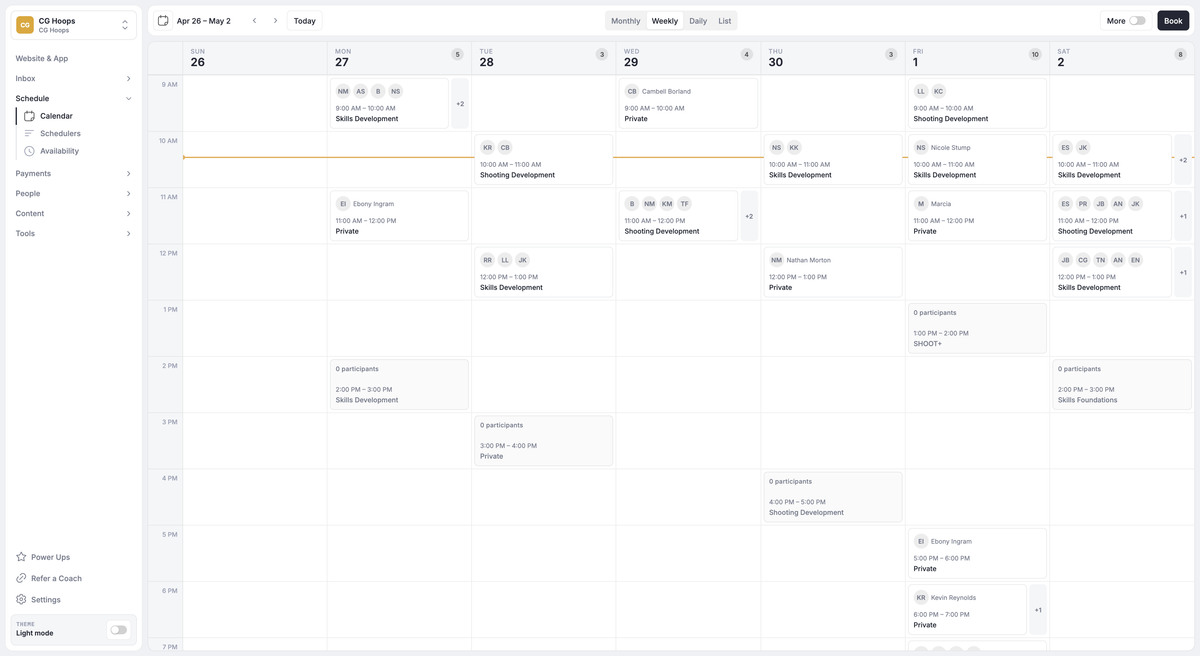
CoachIQ connects the public website, athlete booking, payments, and the ongoing coaching relationship. Its scheduling tools support individual coach availability, Session capacity, and rooms or training areas tied to Schedulers. Athletes can pay when booking or use eligible Credits from a package or subscription.

For a facility owner, the useful connection is what happens after the reservation: athlete records, forms, Programs, and communication stay inside the same platform. CoachIQ serves 750+ sports coaches and training facilities, including independent trainers and multi-location operators.

Verify in your demo: Recreate a busy day with coaches sharing training spaces. Test the exact cancellation rules, staff access, family payment arrangement, and reporting you need. If rentals, leagues, access control, or payroll are central to your business, have those requirements demonstrated explicitly.

Pricing: Varies; monthly subscription with no annual contract. See CoachIQ pricing.

CoachIQ weekly scheduling calendar showing coaches and booked training Sessions

CoachIQ's scheduling calendar. Use your own coach availability and training spaces to evaluate the booking workflow.

A real facility example: Hoop House, a basketball training business in El Cajon, offers private, group, team, and event options. Its published customer story shows how families choose a program and trainer, then complete the relevant information, booking, and payment steps. That is the kind of connected journey to test with your own offers.

2. Upper Hand: Programs and resource management

Upper Hand combines program scheduling and registration with facility administration. Its published plans place facility and resource management, retail and inventory, and staff and payroll tools in Grow.

Pricing: Start is $79/month and Grow is $199/month, with the monthly cost paid annually. Website and advanced reporting enhancements can add cost. A facility evaluating resource management should compare the relevant plan rather than using the lowest advertised price.

Verify in your demo: Book a lesson that needs both an instructor and a space, then add a rental and a program registration. Check which plan covers each task and how staff see athlete history. Compare this resource-and-program workflow with CoachIQ's connected athlete workflow; either can be relevant at different facility sizes.

3. EZFacility: Rentals, leagues, and facility administration

EZFacility's scheduling and operations tools cover facility scheduling, rentals, registration, league management, and equipment or inventory. Its product navigation also identifies memberships, package sales, point of sale, reporting, and staff/access management.

That makes it worth evaluating when managing bookable space and front-desk operations takes a large share of the day.

Pricing: Request current plan pricing for your facility's requirements.

Verify in your demo: Reserve a space repeatedly, change one date, handle payment, and review the resulting report. If athlete development is equally important, test how coaches find training context and communicate with families. Do not assume that a resource calendar alone covers that handoff.

4. Swift: Online booking for lessons and rentals

Swift focuses on sports-facility booking and operations. Its published feature set includes scheduling, packages and credits, memberships, waivers, staff permissions, retail, payroll, and reports. Its rental documentation describes booking facility spaces as Rooms.

Pricing: Request a current quote. We could not verify a public base subscription price during this review; ask for processing fees and required add-ons alongside the subscription.

Verify in your demo: Put a lesson and a rental on the same space, apply a membership benefit, and test a staff-initiated change. For migration, get a written list of what transfers, how balances are reconciled, and which payment arrangements need attention. Confirm these details even when migration assistance is included.

5. Baseline: Facility tools with transaction-based economics

Baseline's pricing page lists facility management, scheduling, memberships, payment processing, and athlete data tracking in its Base plan. Additional packages expand training, marketing, operations, and back-office support.

Pricing: Base is $0/month with a $250 setup fee. Published card processing is 3.9% + $2.79 per transaction. Plus is $99/month and Pro is $199/month, with a 12-month commitment listed for those paid plans.

Verify in your demo: Confirm which package covers your required tools and who bears transaction charges. Calculate costs using both payment volume and transaction count. A subscription-free plan still has operating costs; ask for a complete quote before comparing it with a monthly-subscription platform.

6. eSoft Planner: Choose the modules your facility needs

eSoft Planner's pricing starts with Core functionality for athlete/customer records, employees, marketing, e-commerce, and reporting. Its modular approach lets facilities select capabilities around lessons, rentals, camps and classes, memberships, teams, or leagues.

Pricing: Core starts at $39/month. Treat that as an entry price rather than the total for a facility needing several modules.

Verify in your demo: Ask for one quote covering your full mix of lessons, rentals, and programs. Test how those modules share athlete records, staff availability, and payment information. If you expect to add another sport or location, have the vendor explain the configuration and pricing implications now.

7. Mindbody: Fitness classes and consumer discovery

Mindbody is worth evaluating when your facility's operation resembles a fitness or wellness studio: recurring classes, memberships, staff schedules, and visibility in a consumer booking marketplace.

Pricing: Its U.S. pricing page starts at $79/month per location. Ask which plan includes the resource management, reporting, marketing, and branded experience you need.

Verify in your demo: Recreate the sports-specific details rather than stopping at a class booking. Test an athlete with a family payer, a coach who needs a particular training area, and a package usable only for selected Sessions. Check whether that setup stays understandable for both staff and families.

Compare the total cost and the daily work

Ask every vendor to quote the same scenario: your locations, coaches, required spaces, monthly payment volume, transaction count, and must-have features. Include setup, migration, processing, modules, hardware, messaging, and contract terms.

For example, Baseline's published card rate would produce $1,338 in processing charges on $20,000 across 200 card transactions: $780 from the percentage charge plus $558 from the per-transaction charge. This is an illustrative calculation, not a complete quote or a claim that other platforms process payments for free. Use each vendor's actual terms to make the comparison.

During the demo, collect evidence for the parts of your operation that a feature checklist can hide:

Buying question What to ask the vendor to show
Can we avoid coach and space conflicts? Two attempted bookings requiring the same coach or training area.
Do memberships and Credits follow our rules? An eligible booking, an ineligible booking, and a cancellation.
Can we run camps and collect waivers? Registration with required information, capacity, payment, and staff access to the form.
Does reporting answer an owner's questions? Revenue by offer, attendance, and the available space-utilization report; identify missing views.
Can staff work without excessive access? The same athlete booking viewed as owner, coach, and front-desk staff.
Can we migrate safely? A sample imported athlete, package balance, and documented payment transition.

For a closer look at calendar requirements, use the sports facility scheduling software guide. The following exercises take the comparison into your facility's day-to-day work.

What software does a multi-coach academy need?

Start with one operating workflow, then test it with your own staff roles:

  1. Set each coach's availability and the resources a Session requires.
  2. Create Schedulers with the right capacity, eligibility, and booking rules.
  3. Let athletes book and pay or use eligible Credits.
  4. Review the booking alongside the athlete's record and assigned work.
  5. Send the follow-up through the facility's communication system.

CoachIQ's scheduling tools, athlete management, and Inbox support that connected workflow. Verify staff access with each role before rollout. An owner's view alone cannot demonstrate what a coach or front-desk employee will see.

Test a handoff between two coaches

Consider this sample scenario for your software demo: an athlete trains with one coach on Tuesday and a different coach on Thursday. This is an illustrative evaluation exercise.

Before Tuesday's session, have a staff member check the booking, the assigned coach, the space required, and the athlete's eligible package. Afterward, have the first coach record the training focus, one observation, and the next step in the agreed place.

Then sign in with the second coach's actual staff role. Can that coach find the information needed for Thursday without asking the parent to repeat it? Check which records the role can see and which it should not see. Do not assume that everything visible to the owner is available to every coach.

Finally, move Thursday's session to another available time. Verify the booking and any Credit changes against your cancellation policy, then confirm who tells the family. The test is complete when the athlete, both coaches, and the person managing the schedule know what happens next.

Write down each manual handoff you still need. That list gives you specific questions to resolve before switching software.

Compare workflows before comparing facility size

Main job What to evaluate in the demo
Coach-led training Athlete records, coach availability, Sessions, Credits, Programs, and feedback
Court, cage, or field rentals Resource availability, rental rules, recurring reservations, and billing
Teams and leagues Rosters, registration, fixtures, and team communication
Mixed operations A complete example combining a training Session and a resource booking

A large academy can center its operation on coach-athlete development. A single-location business can center its operation on rentals. Square footage and headcount do not tell you which workflow matters most.

CoachIQ belongs on the shortlist when the athlete relationship connects scheduling, payment, coaching, and follow-up. Compare alternatives against the same example. The sports coaching software comparison covers the broader category and links to vendor sources.

Five workflows to test before switching

1. Athlete self-booking

Ask someone unfamiliar with the setup to book a Session. Check whether they can find an eligible time, understand the price or Credit requirement, and receive a clear confirmation.

Then test a full Session, a coach who is unavailable, and a cancellation. Write down the result you expect before testing.

2. Payments and Credits

Credits let athletes purchase access upfront and use it for eligible Sessions. That changes when payment is collected; it does not guarantee lower no-shows or higher retention.

Test the actual package rules your facility sells. Check expiration, eligibility, cancellation treatment, and what happens when an athlete lacks enough Credits. Review payment processing and subscription terms separately from the software subscription.

3. Shared athlete context

Use athlete profiles to keep relevant information accessible to authorized staff. Agree on the fields and note format your coaches will use.

For development tracking, define a small set of repeatable benchmarks and a review date. The athlete-progress guide explains how to combine numbers, observations, and video without treating Program completion as proof of improvement.

4. Communication and follow-up

Decide which channel handles coaching feedback, urgent changes, and facility announcements. Assign an owner to each channel and tell families where to reply.

CoachIQ supports in-app conversations and SMS through its Inbox. Announcements have a different reply path: responses go to the configured reply-to email. The communication guide explains the channel choices and setup requirements.

5. A connected website and Athlete Portal

Follow the path from a public program description to the booking and account experience. Check it on a phone as well as a desktop.

The Athlete Portal gives athletes a place to return for their training relationship. Confirm that your public instructions explain the next step and that the family can find its booking, messages, and assigned work.

A practical migration checklist

Before rollout Evidence to retain
Map athlete records and packages Field mapping and a sample reconciled athlete record
Configure availability and booking rules Successful and rejected booking examples
Reconcile balances Approved opening Credit balances and package rules
Test staff access Results for each actual staff role
Explain the new process Booking instructions and a named support contact
Pilot with a small group Issues found, corrections, and rollout decision

Keep the existing system available until the pilot proves the new process. Setup time depends on data quality, payment arrangements, staff training, and the workflows you need. A fixed promise of a one-day migration is not a useful planning assumption.

What does sports facility management software cost?

CoachIQ pricing varies. It uses a monthly subscription with no annual contract; see pricing for the current options.

Compare total operating cost: subscription, processing, setup, migration, optional services, and any fees tied to transaction volume or location count. Ask vendors to quote the same operating scenario so you can compare the offers fairly.

Frequently asked questions

Can one platform support several coaches and sports?

Yes, provided its scheduling, athlete records, and staff controls fit the operation. In CoachIQ, start by mapping your coaches, Schedulers, and training offers. Test each sport's booking rules and every staff role before rollout.

Should a larger facility choose rental software?

Choose by workflow. A large academy may organize its work around coaching and athlete development, while a smaller site may primarily rent courts or cages. Test the mix of training and rentals your business actually sells.

Will Credits reduce no-shows?

Credits collect payment before eligible Sessions are booked. Attendance outcomes also depend on cancellation rules, reminders, and the athletes you serve. Measure your own no-show rate before and after changing the process.

How should we evaluate CoachIQ?

Bring a real booking example, a package, and your staff roles to a walkthrough. Follow the athlete from booking and payment through coaching context and the next message. CoachIQ serves 750+ sports coaches and training facilities.

Test the work your staff repeats every week

Choose software that can carry a real athlete through your operation with clear handoffs between coaches and staff. Book a free demo to walk through your facility's scheduling, payments, and athlete communication in CoachIQ.

POWERED BY

CoachIQ Logo