Podcast
How to get more training clients
Tim Sada of Tim Sada Training in Ocala, Florida, on where his families come from, why he charges $20 for a trial session, and why he asks every new parent to call.
If you want to know how to get more training clients, look at where your last twenty families came from. If most of them came from one place, that is the weak spot. Every lead source has a slow month, and when yours hits, nothing else is there to cover it.
Tim Sada runs Tim Sada Training in Ocala, Florida. He played college basketball at St. Thomas University in Miami, played pro in Lebanon, and now trains kids out of a private school's gym while he works toward a building of his own. He sat down with Brandon Evans, who owns a basketball training facility, to talk through where his families come from, why he charges $20 for a trial session, and why every parent who messages him gets asked to call.
How do you get more training clients?
Get them from more than one place, and treat each one like it matters when it shows up.
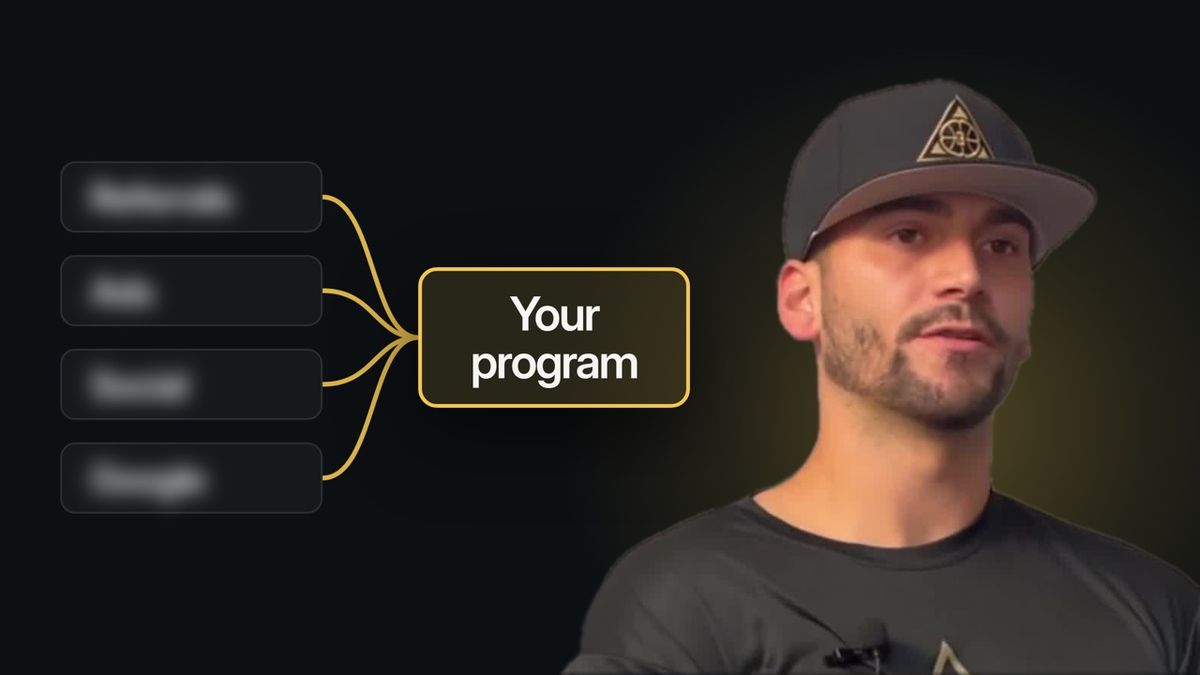
Brandon Evans sorts lead sources into four buckets. Google and your website are "the stuff that you do once and it pays off later." Then there are paid ads, referrals, and your own effort: posting, reaching out to people, working your email list.
This is his fourth year running his programs and his third with a facility, and the lesson he keeps coming back to is that "you can't rely so heavily on any of these avenues." Tim's mix looks like that already. His families come from word of mouth, from the Meta ads CoachIQ runs for him, from his own posts, and a smaller number from Google.
How did Tim Sada build a training business without his own gym?
He started with a driveway.
Tim moved to Ocala in middle school and got cut from his middle school team as a sixth grader. By eighth grade he was starting, and by his senior year of high school he was an all-state player. "I didn't have a trainer or a facility or anything in this area in Ocala," he says. "I would just be in my parents' driveway all the time by myself mostly."
He played four years at St. Thomas University, made all-conference, and then got noticed at a pro combine in Las Vegas, where he made the top twenty out of about 250 players. That led to a pro contract in Lebanon, where he was a top five three point shooter in the league as a rookie. He had already started training kids in Ocala during college summers, back in 2017.
Today he still has no building of his own. He trains groups at a nearby private school's gym, thanks to a long relationship with its athletic director, Coach David Miller, and runs private lessons at families' homes. Most of his athletes are fifth grade through high school. If you are in that stage too, our guide to starting a sports training business without a facility covers the same road.
How do families sign up for training with Tim?
Groups book online. Privates go through him.
Group sessions are sold as a monthly membership on his website. "They can choose how many sessions they want to pay for per month," then pick their spots on the calendar, which he keeps at least two months ahead so families can plan. Private lessons he sets up directly with parents, because they could be in a gym or in someone's driveway.
Every so often he also runs an instructional open gym: a two hour block where kids play five on five, full court, split by age, and he stops play to teach.
For years the business grew on word of mouth alone. Then, in Tim's words, "once I, you know, spoke with CoachIQ and we developed a better website and got more organized, it's only continued to grow and get better."
Should you charge for a trial session?
Tim does, and it is working.
His trial session for the group program costs $19.99 and runs an hour. "Right now I have it at 19.99, so 20 bucks and they can try it out." Even if it is not the right fit, the family got a real workout. And "most people that have been doing it recently have stayed and got memberships."
Brandon's view is that "a paid trial session is a sign that the parent believes at least a little bit in what you're doing." The parent got their card out, filled in their information and clicked pay. Even a dollar counts: "that's still some sort of skin in the game for them."
There is a practical upside too. In CoachIQ the card a family pays with is saved to their account, so when you get them on the phone after the session, the membership is one checkout away. If you are setting prices from scratch, see our guide to pricing private training sessions.
Why should you call every new lead?
Because almost nobody else does.
When a parent messages Tim, he gives the same answer every time: "Hey, give me a call because I'd like to speak with you." He wants them to hear his background before they decide, since plenty of trainers in any market have no real credentials to talk about.
Brandon thinks this is one of the most underrated things an owner can do. Text is fine for a family already in your program asking about their account. A new lead is different, wherever they came from. Five minutes on the phone, sometimes thirty, "is a signal to the parent that you care." Call a lot of the big box training places and you get the front desk reading off days and times. He has seen it in his own numbers: "handling your leads that come in over the phone makes such a massive difference."
For what to say once they pick up, see our breakdown of the basketball trainer sales process.
Where do paid ads fit?
As one of the four sources.
Tim's ads are one of his biggest sources right now: "CoachIQ has been running Meta ads on Facebook and Instagram. I've been getting a lot of people from that."
Brandon learned the other side of it this year. With more money to spend on marketing, he leaned hard on ads, and "a couple months ago, we didn't get a single new lead that came in." Google, referrals and social brought nobody that month either. "I spent all my money on ads and I had zero people come in."
His fix was to stop treating any one channel as the answer. "All four of these avenues have to be working at the same time," because none of them brings people in every single month. If you are weighing ads, our guide to Facebook ads for sports facilities walks through the setup, and CoachIQ also offers done-for-you ads.
How do Google reviews bring in more training clients?
They are the source that keeps paying after you stop working on it.
42% of Brandon's applications this year came from Google, and he has 133 Google reviews. He thinks the reviews are a big reason he shows up so often.
The way to get them costs nothing: "literally just ask." The best moment is right after a win, when a parent texts you about a move their kid hit in a game, or a couple of months in when things are going well. Tim does the same thing. When a parent sends him something kind, he asks, "do you mind putting that in a Google review for me?" His reviews, he says, "they're all genuine."
Your Google Business Profile and your website do the rest. Our help center has a walkthrough for setting up your Google Business Profile, and our guide to building a website for your training business covers the site side.
How do you turn one private client into a small group?
Price it per player, and let the kids bring their friends.
Tim does not run a formal referral program. What he does instead: when a kid he trains privately mentions two or three friends who play with him at school, "I will give them like a friend discount." They train together as a small group, still private, still at a home or a park, and each player pays less than a one-on-one.
The kids compete against each other and hold each other accountable. Tim fills the same hour with three or four paying players instead of one. "So it's a win-win because now I'll make more money in that time frame, right?"
Brandon's read: "it's essentially a referral program, just in a different verbiage." The economics behind it are in our post on group training vs individual sessions.
What comes next for Tim Sada?
A building of his own.
He has spent the last year researching land in Marion County. The warehouses he has looked at are either far bigger than he needs or so old that renovating them would cost about as much as building, so he is leaning toward building new. He is saving and reinvesting money from the business, and talking with a few potential investors. "My goal is within the next two years."
If an investor is part of your plan too, Ep 34 with Sam Garvin covers how to raise money for a sports facility.
Where to find Tim
Tim Sada is the founder of Tim Sada Training in Ocala, Florida.
Website: timsadatraining.com
Instagram: @timsadatraining
If you want your group memberships, booking calendar and payments running in one place, book a free demo with CoachIQ. CoachIQ is trusted by 750+ sports coaches and training facilities.
Full Episode Transcript
Read the full transcript
The following is a lightly edited transcript of the episode above.
Brandon Evans: Welcome back to another episode here of the CoachIQ podcast. I am your host today, Brandon Evans, a fellow basketball training facility owner or sports training facility owner. Today we have Tim Sada. Tim, I'm gonna hand it over to you, give everybody a synopsis of who you are, what you do, where you train. Let's hear it.
Tim Sada: Thanks for having me. Yes, Tim Sada. I have a basketball training business right here in Ocala, Florida, which is central Florida, north central Florida, about an hour north of Orlando area. I'm originally from South Florida. I grew up playing baseball, football, and basketball in a sports family. So sports and competition and the benefits of that has been in my blood since I was born. I have two older brothers that played college baseball. So it's just been very intense. And then even South Florida as a sports culture in general, you know, Dade County, Broward County, Palm Beach, the competition down there is insane. And you see it in college football, the all the top programs recruit. So that's where I got my start. Then later in middle school, my parents, you know, we end up moving to Ocala. And it was there were some good things going on in sports, but it wasn't the same level of competition. And then also I started falling in love with basketball. And my dad had played college basketball, and I always had And listen to his stories of him traveling around the country and playing. And I was so intrigued by it. And my brothers didn't play. So I was like, Well, I wanna play. So I tried out for my middle school team here in Ocala when I first moved here, which I can't believe is already 20 years ago. And I got cut. I didn't make the team and as a sixth grader. So I was upset. And I started working really hard from that moment, from being twelve, thirteen years old, to where I by the time I was an eighth grader, not only I made the middle school team, but I was a starter. And then my freshman year, the following year, I was on varsity as a freshman at one of the bigger public schools here too. So that was and we had a pretty good talented team. So every step of the way, there was development. And then continuing through high school, you know, I was a freshman on varsity, so I didn't really get a lot of playing time and I wanted to play more. So then the next year, played more, became one of the best shooters in the county, right? Then still didn't really get a lot of playing time. So I transferred to another school where I could get more playing time and opportunity, then became an all county player. Then the next year, my senior year, all state player. So every single year I got better. And I don't just mean with the stats or the accolades, I mean like even the mindset and being a student of the game and watching more, working out, better diet, just to being a complete ball player and treating it as a professional, because I had these big goals of playing. But through that whole process, I didn't have a trainer or a facility or anything in this area in Ocala. I would just be in my parents' driveway all the time by myself mostly. I had some friends and stuff that would help as well. But it was mostly just me by myself. And I had always thought since that age, from middle school through high school, growing and then getting the college interest when I became an all-state player and I was starting to get recruited. I'm just like, man, I one day when I'm done playing college ball or whatever it may be, I want to come back and start a training business and, you know, take over this area and help kids that need it, because there's just nothing here for them. And Then I went on and played college basketball at St. Thomas University for four years and was an all conference player, broke a couple records there. And we had one of the best seasons in school history, my senior year. And again, same thing, continue to develop. And that's why I keep saying that, because my freshman year, just like no for almost everybody, I didn't play a lot my freshman year, but I still was in the running for freshman of the year of the conference with very limited playing time. So I'm like, man, I noticed I was hungry, man. As soon as I get the more opportunity, I'm gonna do well. And again, keep continuing getting better each year. And my stats reflected that. I put up better stats each year, freshman, sophomore, junior, senior as a in college. And you know, I played at a small school, I played at a but we were one of the top NAIA programs in the country. So even though it's a smaller level, it's not a D one, we were the top of that smaller level. And exactly. And there's a lot of great I was just down there this weekend because of homecoming and I watched the team we have now and I'm like, dang, these guys look great too. I mean, these always look like D one players. So
Brandon Evans: Yeah, still quality. Yeah, I agree.
Tim Sada: You know, and that's one thing I tell all my kids as well. So then after that I get invited to go to Atlanta and Vegas for some overseas combines right after my senior year. So this is twenty eighteen. And I go to Atlanta and I absolutely killed it. I was the leading scorer in the whole combine and I got nothing out of it. I got nothing out of it. No nothing. I and I was lighting it up. So I'm just like, man, I'm a broke college kid. I just came out here and did my job. I treated it like a business trip, just like in college, did all the right things. Nobody cared. No one really recruited me. And I'm like, and you know, I'm a six four shooter, but I can play the one. I'm more of a shooting guard, but I play the one. But I'm not like a crazy athlete. I'm not windmilling. I'm not 360. I'm not doing that. I'm a sniper. That's what I do. But I still thought I played well enough. But I'm like, okay, I'll just keep working. The following month I go out to Las Vegas and I played in that combine. There's two hundred and fifty players there. And half of them are D one guys. The other half were like myself, NAIA D two, but you had to be all conference, which I was my senior year, you know, or like player of the year to get invited, 'cause invite only. So all the guys there are really good players. Well, I ended up making the top twenty out of the two fifty and we played like a little championship game. Well, right before that championship game, there was a scout for an overseas team that saw me and he put me in touch with my agent, and then I ended up going and playing Pro Ball overseas after that. So it was quite the journey. Well, my rookie season I was a top five three point shooter in the league in Lebanon that I was playing in my rookie season. And then they had a revolution in the country. And then right when it looked like we're gonna come back to start playing is when COVID started. So it's just been craziness, right? But I always had this in the back of my mind to do this business. And I actually started it as a side business back while I was still in college in twenty seventeen, 'cause my college was in Miami, but my parents lived in Ocala. So in the summer I would leave St. Thomas, come back to Ocala, and I'd work with kids on the side, you know, just as like a little side business and also helping a lot of kids in the area. Cause every time I went to a park or the YMCA and I'm watching kids and they just don't know how to play basketball. They don't know the proper fundamentals and I'm like, Man, they need someone to teach And it doesn't even have to be a bunch of advanced skill work, it's just they need to learn basketball from the basics, from the basics, and then we'll build up to that. We'll get to the advanced stuff later. So anyways, I know I went on a little bit there, but that just gives you like the full picture. And now I'm at a point where I've had offers to go play since COVID several times. I actually just had one two months ago. But yeah, so it's kind of crazy because I'm like, it's hard as an athlete, as anyone that plays ball, and I'm sure you can you know attest to this. You never want to give it up. You especially when you've worked so hard. I'm pretty sure it was Rick Pitino that said the hardest workers are the last ones to give up. And I a hundred percent agree with that, because I don't ever give up on anything. And sometimes I have to remind myself that you also have to evolve. And as much as I've wanted to play these last few years and I've stayed in shape, where I was playing right now is not the best, right? Because of the things going on in the world in the Middle East. So there's that part of it. I've built this business where I'm helping so many kids and I love it. I love seeing these kids get better. And a lot of them are not even just getting better at the sport. I have parents coming to me and tell me, hey, you know, he or she's they're getting better grades. They're more focused. They're more respectful at home because you've been holding them accountable in the sessions. So I when I hear that stuff, man, that's why I do this. That is a hundred percent why I do it. If they get better at basketball and they go play college ball, which a few of them have, and I've been happy for that. But even if they don't reach the levels of college or pro or anything like that, if they learn how to be successful and they learn a process. Kind of like what Nick Saban is talking about in his documentary, if anybody watched that. It's the same thing. I want these kids to learn process of how to be successful in life beyond the sport. So that's why I've made the decision that, you know what, I'm gonna, you know, put both feet in the ground. I'm gonna stay right here and I'm gonna build something that this area really needs and the surrounding areas too. So yeah man, I w I and then you mentioned facility. That's the next goal, man. I'm working hard every single day to I have 'cause right now I have a relationship with the athletic director of a private school nearby who's awesome, great guy. Coach shout out to Coach David Miller. And I've been using their school for years to for AAU, for the training business, for many things. But the ultimate goal is to get my own facility. So that's what I'm working
Brandon Evans: Yeah. Yeah. No, it's always I love to hear like the journey of how people get to where they're at. 'Cause like your journey versus my journey is you probably can't get more opposite than that. Like I didn't play past high school. I started coaching when I was fifteen and like I just knew that's what I wanted to do. Like I just knew that's what it was for me. But like you were the exact opposite. But we still have kinda ended up in the exact same place. So like I just love to hear all the different ways people get to the same place, pretty much, which is ultimately giving back to the sport that you love growing up. And to your point about it being you know bigger than basketball, I know it's a phrase that a lot people say, but it really is. Like kids, I hear this in my gym all the time, like it's just like a part of their lives and it's an area where they can go to learn de stress, like whatever they need. It's just a positive area that the kids can come to. And that's why I do it. This is the same thing. Like you already said that's why you do it. Positive area that they can learn how to succeed at something. And that's an invaluable skill 'cause like the ball's gonna stop bouncing at some point. It just it always will. Like you're never gonna play forever. So yeah. Gets I wanna hear like where your business is at right now. I know you just touched on it a little bit at the end. Like what does the structure look like right now? Do you have a specific niche that you work with? Like I specifically work with like fifth through tenth graders, eleventh sometimes. Are you doing youth all the way through, like college pro? What does your day to day business look like right now?
Tim Sada: Okay, so that's a great question. And it's a little bit nuanced because for the majority of the kids, they're about the age that you said, like that end of elementary and then like to the beginning of high school or middle of high school. Like those are the bulk of the kids I'm working with. But I also don't limit it at all. Like I've also trained kids that are three and four years old. And I know it sounds crazy, but w I've had several parents that are like, you know, we just want them to get familiar, you know, start touching a basketball and I what I do with that age is Just teach them what a rebound is. Teach them what an assist is. Teach them how to even properly pass the ball. And we'll use a little small ball just so they kind of get those movements at a young age. Cause I remember playing baseball at three years old, you know, playing T ball. And I had an advantage of having two older brothers that were teaching me stuff at three and four years old. By the time I was five and six, I was so much further ahead than the other kids my age. So for me, even if it's just starting with these kids real young, doing even if it's just a s a short little session, just little times here and there sprinkled in. They get a little bit of a taste of it. So by the time, you know, a couple years down the road. So I've worked with kids as young as that age, right? Real, real little. And then last week I was working with another overseas pro who's in his twenties. And I have plenty of kids in college, high school. So the range is unlimited. I'll work with anybody. And I've even put that in my Instagram bio for all players. So I it doesn't matter. Male, female, young, older, whoever wants to get better at the game, I'm here for it. But if we're talking strictly business, it is mostly that. Like what you said. A lot of kids I have are Fifth grade to high school.
Brandon Evans: Yeah. What does your like week to week look like what are you doing tonight? What's your schedule look like tonight?
Tim Sada: Okay, so that's a good question too. So I go I do a mix of group sessions, small group sessions, and private lessons. So today, today is all private lessons, and then tomorrow I'll have some private lessons in the morning, and then in the evening I'll have a I have two group sessions back to back in the gym. And then the private lessons can be pretty much anywhere. I'll I a lot of you know, a lot of people have hoops at their house. So a lot of clients are like, Hey, can you come by and train? You know, my son, you know, even if I'm over here at work or I may be able to stop by and watch some, but it gets busy sometimes for them. So to make it available for them to get in some type of high level training while they're while their kid is at home, maybe right after school, yeah, I'm there. So I'll do that. And then like I said, I have the group sessions in the gym as well. And then every so often, which I have one in a couple weeks come in, I do instructional open gyms. Cause as most coaches know nowadays, they're Aren't enough kids that are playing ball, like going and just playing at the park or getting runs, right? Training is great. We need training. Obviously, that's why we're here. That's why we do what we do. But I tell kids all the time if you're not taking what you're learning in these sessions and then going and applying it and going and playing, it's not gonna make you as good as you could be as quickly as you want it to be. You it's gonna take longer. So the you know, the faster that you put it to action, the more you're gonna retain, number one. Mentally, but also you're just gonna play better, or even if you do make some mistakes, work through the mistakes and go, okay, in this scenario I should do XYZ. And there's only one way to really find that out is to go do it and go play. So I've been doing these instruction open gyms where I have a two hour block in the gym and I invite kids of all ages and then I'll split them up by age group as best as possible. And I just let them play five on five full court, like a real game. And then, you know, here and there I'll stop it. Hey, you know You should have cut or hey, you need to pop out, you need to go screen away. You're not trying to get open, whatever, just little things that they don't realize to help them out. So when they keep playing, they'll kind of remember that and hopefully retain some more things. But also just to let them get up and down and play. Cause they need to play more than just, you know, doing dribble moves or whatever other stuff are in the training session.
Brandon Evans: Yeah. No, that's it's so funny you say that. I just added that to my gym like earlier this year and like one, they absolutely love it. Like 'cause then you know they come to training with us and it's always training and we're always like on about everything. But for them to have an opportunity to be with the other kids that they train with and you as a coach and just get to play a little bit, like they absolutely love it. And to your point, like They just need it. Like I they absolutely need it. I don't I'm not sure that kids go play at the Y or go play at the rec or go play pickup very often anymore. I know it's kind of like a I don't know I don't know if it's a trend to say that, like, but I've just been seeing it more and more often. But us what we can do to fix that instead of just saying it is, you know, offer that space for them to do so. And like when I started for the basketball people listening, like you'll know. When I started doing those runs, like we had to teach them how to play pickup. Like they didn't know what checking the ball was. They didn't know like keeping score or like they were looking at us like, What's the score? Like, you guys gotta call it out. Like it was just like they didn't know that the winning team keeps ball, like there's just all these little things about like playing pickup and just being around other kids and figuring it out. Like we make like shoot for ball if there's a an argument about an out of bounds or a call, like just leading them to figure things out on their own along with all of your other training that you do. It's like a simple it's a simple thing, but providing that space for them is something that they really adj enjoy, appreciate and need. So how do people get into your group sessions? How do they get into your private lessons? How do you structure all of that? Like if I come to you and I say, or if I go to your website and I say like I want to train with you, what does that entire process look like?
Tim Sada: So right now, if you if anybody wanted to sign up, we've partnered, I've partnered with CoachIQ for this reason to have a website to where they can look and you know choose a membership for the group sessions or how many you know sessions per month. That's how we structured it, and they can book it right there. They can choose how many sessions they want to pay for per month. And then look at the calendar right after that and go, you know, okay, Coach Tim's in the gym on Tuesday, seven PM to eight P. I'm gonna book that session. And for the following month as well. I try to stay at least two months ahead so that way people can plan ahead of time. So that would be the group sessions. The private lessons I do directly, I have parents just reach out directly and I'll set up because it varies, right? It could be in a gym or it could be at their house, it could be kind of all over. So that's a little different. But the way that the business grew and people heard and found out was more word of mouth in the beginning, which was great because I had trained a lot of people in the area and it started to grow. But once I s you know, spoke with CoachIQ and we developed a better website and got more organized, it's only continued to grow and get better. So I'm thankful for that. But yeah, just to answer the question, it's everything's right there on the website. Simple enough. People can just book it and but I also encourage people to reach out to me too, because you know, people usually have questions. So I anytime someone messages me directly, I always say, Hey, give me a call because I'd like to speak with you. Just so they get an idea of my background, you know, the credibility, right? I tell parents all the time. I because you see a lot of trainers that don't really have credibility and they may teach some things that are decent for the kids. It's not like everything is bad. But then there's like a focus on certain aspects of the game that don't really translate a lot of times to real games or for what the goals are. And my training is not cookie cutter. Yeah, you're gonna do some things this like my ball handling mostly is gonna be all the same for people. There's levels to it as you get, you know, more advanced. But there's a lot of things that I customize, man. A lot of things. Like everything is custom. So I look at a kid's strengths and weaknesses and when I analyze what they're doing, and I can pinpoint, you know, strengths and weaknesses pretty well. So then we're gonna work on that. We're gonna improve your strengths, you know, continue that. And then we're gonna fix whatever weaknesses you do have. And we're gonna make that, hopefully make that a strength. Or it with the worst case, it's not gonna be a weakness anymore. We're gonna make it to where and my goal for every single player is to make them complete basketball players. So yes, we're gonna work, everybody's gonna do ball handling, you know, shooting, defense, footwork, basketball IQ. We're gonna talk about scenarios within real game things that happen. But the focus could be different for each player too.
Brandon Evans: Mm-hmm. Yeah. Do you have people come in for a trial class at all?
Tim Sada: Yeah. So I did start that recently for the group sessions. I do have a trial session where people can try it out and see if they like it and then get the membership afterwards.
Brandon Evans: Mm. Mm. Do you do that free or paid? I just asked because that's like the ongoing argument between a bunch of the coaches. Okay. Yeah.
Tim Sada: Right now I have it at nineteen ninety nine, so twenty bucks and they can try it out. You get a and you get an hour session out of it. So I think it's a great deal s cause even if you're like, Okay, it's not the right fit for me, you got an hour, you know, great workout. But most people that have been doing it recently have stayed and got memberships, so
Brandon Evans: That's the thing about the reason I ask. A paid trial session is a sign that the parent believes at least a little bit in what you're doing and they actually want to act to show up. Like if they pay twenty dollars for your session, that means they got their credit card out, they signed up for the entire thing, they put in all their information and they clicked pay and showed up. And a few things for that. One, this is just Nice feature in CoachIQ is it keeps their card on file. So if they do want to sign up for a membership, it's as simple as getting on the phone and saying, Hey, wow, what would you like? Yeah, your card's on file. I can get your account set up right now. That's a huge advantage. And then two, if they pay, even if it's one dollar, like I've seen coaches do one dollar trials, that's still some sort of skin in the game for them. And When I've done free trials in the past before in my gym, I used to do it for the first like year and a half. I do it now, but it's a little different because I sell like only six month memberships. So it I used to think of it as like a nice gesture, like a low barrier to entry, which it is, but I would spend a lot of my time talking to people and they would just not show up because there's no skin in the game. Or they would come and then I would talk to them after. And then it's the whole thing about getting their card out and getting them to pay, which is a whole other ordeal. But I do like what you said. If people do reach out to you, you just say, Hey, give me a call. That is such a big deal that I think a lot of coaches and facility owners don't fully recognize is handling everything through text is I just talked about this the other day. Handling everything through text while it is nice and convenient and is it's perfect for like you know little things. Like if a parent's in your program and they are like, hey, my account's this, like boom, fixed it. Like, of course, that's totally fine. But if you really want to give a parent or a prospective parent or a lead, whether they come from a referral, whether they come from ads, whether they come from social media, like wherever they come from, giving them a call, like the time out of your day. Even if it's just five minutes, five, ten, fifteen, sometimes those calls go thirty minutes, I'm sure you know. That is a signal to the parent that you care because when you go to a lot of these bigger facilities, like these the massive, you know, big box training places, they're not gonna do that. Like and if you call somebody, it's gonna be somebody at the front desk and that is just like, yeah, or this is the day and time. So I say all that to say like handling your leads that come in over the phone makes such a massive difference. Like I have personal data on this in my gym. And of course a lot of the coaches that we work with at CoachIQ. So I just wanted to point out that portion of what you said was awesome. Like that is something that every single coach should do if they want to take maximum advantage of everybody that comes their way. So which leads me to my next question. Where you mentioned a little bit about You used to only be word of mouth referrals, which is great. That's an amazing avenue. It's one of the best avenues you can have because the people come in like pre-sold on your program. Where do your other leads come from? So like you have your word of mouth, do you utilize I know a lot of coaches utilize social media heavily, some just utilize their website and their SEO. Like I come up on Google quite a bit. I think I forty two of my applications came from Google, forty two percent. Almost fifty, it's quite a bit. So where does the majority of your interest come from?
Tim Sada: So right now it is typically one of three for the majority of it. And that would be word of mouth like we established. Now CoachIQ has been running meta ads on Facebook and Instagram. I've been getting a lot of people from that. So that's been awesome. And then I do have some through social media that I've posted separate from like the actual ads that are being run by CoachIQ. Like I'll just post the story or I'll post a reel or I'll post something on Facebook and then someone will comment on it or you know, because I've built a following in this area just from you know playing high school ball here and being known as a basketball player in high school here, going away to college. But I also came back in between, like I said, and started as a side business. And I also even helped coach my old high school as an assistant coach for a year while I was getting ready. To go overseas. So there, you know, I met interacted with a lot of those parents and kids, and I started, you know, I started making this is the ice in the vein shirt, but I started making some merchandise and stuff back then on my own and going to local shops and printing them because the kids, you know, I made a couple and the kids like the design, so I was like, all right, great. So I started giving out shirts and stuff, and it's kind of built itself organically. But yeah, I would say if I had to the three are, yeah, it would be word of mouth. The meta ads that CoachIQ is doing a great job with that we're getting a lot of people from, you know, or just social media naturally, like posting and then the smaller one, I would there's a fourth one, but it's not as frequent is like someone will find me on Google. I've had that a few times recently. Like, hey, I was Googling stuff in the area and you popped up. Which I do have some Google reviews, and they all have been great. So I think if people are seeing the reviews that, you know, okay, hey, let's reach out to this guy.
Brandon Evans: No, Google reviews are massive. That's I think is a big reason why forty two percent of mine came from Google. Which is a crazy number. What just little hack for anybody watching if you want to get more Google reviews. They the easy way, like no spending no money, is literally just ask. Like they'll typically say after somebody has a big win, like whether they text you that like, They did this move in the game, or about like two months in, if they're still on subscription, you can s automate a reminder if you want. I typically take the manual route and just wait for them to text me, or if I ask them how things are going and they say something very positive, I'll just say, Hey, would you leave this Google review? But what I did that got me like 85 stars was I just ordered a bunch of shirts, like cheap shirts, they were like seven or eight dollars each. And I just said you can get a free shirt if you leave us a Google review. I didn't say five stars, like I didn't do anything like that. I just said leave us a review, you get a free shirt. Got like eighty, eighty five stars, and now dang near every search we pop up as number one, just because we have so many, so it's a little trick if anybody wants to use it.
Tim Sada: That's interesting. I like that idea a lot. And that's interesting that you said eighty. I think la when I checked just now I have fifty five stars. So now I guess I need to do the T shirt thing so I can get up to eighty.
Brandon Evans: So it's funny 'cause like I had that fifty before. So I have a hundred and thirty-three now total. It was eighty on top of everything. Cause people like they made extra accounts if they are already left a review. It's just such a simple thing. I forget where I even saw it. I saw it on like a general business video and I was like, I'm gonna try it. And like I posted it and I left them up in my gym and Shirts were gone very fast. Like and it cost me like five hundred bucks to get all the shirts, but like I've made that back in forty two percent of my applications being from Google. So that's just a fun little trick that people can try.
Tim Sada: But I'll add to that too though, I that must mean though that you have a good product because just to be clear, I yes, I think it's awesome that idea. And like I said, I might even have to steal your idea 'cause I think 'cause I have shirts already, so I might as well, you know, and I've The what I did recently, these are like the ice in my vein shirts. That's why it's got the icicles. You know, always priding myself on being a clutch player, pressure moments, always wanting the ball. Something my dad taught me. He again, he played college ball. It's like, hey, you want the ball at the end of the game. Like you want to be the guy that takes the shot and all that stuff. But anyways, I do want to say though, you must have a great product. And I can almost guarantee that because same thing as far as with the reviews I have, they're all genuine. Like I've had pe the same in the same way that you said, like when people text me something really nice, I'll say, Hey, can do you mind putting that in a Google review for me? You know, because it is genuine. You really mean it. I really am helping your child. So that means that the training and what we're doing is working. It a hundred percent. It's just that we know how things go. Life gets busy, people forget, they don't do the so an easy way to get them to make sure that they do it is like, Hey, here's a shirt, leave us Google Review. You know, like that's so I like that. I like
Brandon Evans: Yes, ex exactly. Exactly. That's all it is. Like it's not you're not like saying like hey, you have to give me a five star. That's why I didn't include that. Like, just give me a review. So they leave their genuine review and they just happen to all be five stars. Yeah, it's just that it's just simple ways to make people take action. Yeah, when I look at you know, where leads come from, there's always the
Tim Sada: There you get that's what I'm saying. You must be doing something right, man. So there it is.
Brandon Evans: There's always like the SEO from Google. That's kind of the stuff that you do once and it pays off later. Your reviews, things like that. And then there's your paid traffic. And then there's your referral paid traffic being the ads that you talked about. Then there's your referrals, which is pretty natural. Like you do a really good job. So boom, people refer. And then there is I view it as like my own effort or the coach's own effort, which is, you know, social media. You're posting things on social media. You're reaching out to people, you're working your email list, like things like that. So that's a big lesson that I've learned even this year. Like this is my fourth year running my programs, third year with my facility, is you can't rely so heavily on any of these avenues. Like when I first started, I relied super heavily on social media. Like that was my Big thing was social media. I had my website, which that was bringing in some people, but I didn't have many reviews. My website was super new, so it wasn't very populated on Google. And I relied super heavily on social media. And even this year, like now that I have a little bit more money to spend on marketing, I rely s I relied super heavily on ads. And a couple months ago, we didn't get a single new lead that came in. So like that was a big lesson for me that like all four of these avenues have to be working at the same time. Because not every single one of them is going to bring in people every single month. Like, I didn't have anybody come in from Google, I didn't have anybody come in from my social media, I didn't have anybody come in from referrals that month. So I w spent all my money on ads and I had zero people come in. So like it's just a lesson that i you can't put all your eggs in one basket when it comes to bringing people in. But talking on referrals. I always think this is interesting in word of mouth. Do you do anything specific for like do you do any like referral program, any type of like promotion for referrals, or does it do you just kind of let it happen?
Tim Sada: Mostly I've you know, I'd like in before partnering with CoachIQ, I was growing based on word of mouth solely and it was working. So I didn't change that because it was people were coming to me. My referrals were bringing referrals. So when that was happening, I was like, okay, I'm gonna let that happen naturally. So that's how I did that. But I do one thing I do say and I do like try to I guess this would be a blend. It's still more of the private because I would do it at somebody's house or maybe at a park or somewhere that they could meet. I will give them like a friend discount. Like, hey, you know, I've been working with your son for however you know, a month or two and he's been doing really well. You know, he mentioned that he has, you know, two or three friends that also play with him at the school. If they wanna come and do a small group, but it's still kind of a private lesson, it's not like at the gym or membership, it's just still private, but it's a smaller group instead of just one on one. There's some different things we can do because now I can have the kids guard each other, compete against each other, and do different drills that benefit all of them. And if you do that, I will discount the session per player. So instead of it being, you know, a private lesson that is which is the most expensive because it's one-on-one. If there's three or four kids instead of the one, I'll discount it for everybody. So it's a win-win because now I'll make more money in that time frame, right? So it helps the business. You get set more kids involved and seeing the training. So that naturally grows it. And then also the kids are getting better because they're competing against each other and as friends and they hold each other accountable. And everybody has different strengths and weaknesses. So they can kind of help each other and work together. So that's that would be one way I would say. So not necessarily a specific referral program, but I do think it does have an incentive, like, hey, bring some friends 'cause we'll discount it and it help it helps everybody.
Brandon Evans: No, that's exactly it's essentially a referral program, just in a different verbiage. That's there every coach has their own little way of doing that. Like I just find them very interesting. Like I for example, what did I what did I do a couple months ago? I ran a promo that was what was it? It was a I think it was a year training free if you brought in three people. And like that's like again, I sell like six twelve month memberships. So that's a lot of money for me. And that's a lot of work for the parent, obviously. So a year training is worth it. But there's just a million ways to do referral. So I always like to ask that question and see what different coaches do. And I find that very interesting. So before we wrap everything up, I wanna talk about where you're going. You know, obviously you mentioned you wanna get into the facility game, what steps are you making in the next months to the year to make that happen? How far away do you think you are from getting that facility? What is on your mind when it comes to the next steps?
Tim Sada: That's great question. So I've already been the last year been researching areas. There I'm in Marion County, this is where Ocala is, and there's a lot of land available. So I've been just researching the right spot and where it'll work. There are some warehouses that look like okay, maybe you can do a renovation. That's been a little more difficult because they're they've either been way too big, these monster warehouses that I don't need all that space, or some of them have been like Pretty close to the right size, but they're so old that it's going to take so much renovation that it's like I might as well just build something new. So I'm looking at more of going just building my own. But again, finding the right piece of land, saving and investing the money from the business to grow that, to then make that investment. And also speaking with investors. I do have a few that potential investors that will would want to do that too and partner. So it's just it's a matter of time. My goal is within the next two years. So I want it before that. That's my goal and I'm working hard every day again, saving investing money to do that.
Brandon Evans: Nice. We just had a liter I don't know if you saw it but last week, for anybody watching too, we just had an episode go up with one of our CoachIQ investors. So and they covered how like raising money for your facility and like if somebody approaches you for that, like the details of all that. So if you haven't watched that, sounds like it'd probably be a good watch for you. I can send it to you after. Yeah. Yeah, it just came out last week. It is super interesting.
Tim Sada: I d yeah, I was gonna say please send it to me because I didn't catch that and I really wanna watch that. Yeah. Please send it to Awesome.
Brandon Evans: Well cool. This was very fun, Tim. Let's I'm gonna wrap everything up here. Where can we find you? We're gonna put all your socials and everything on screen here.
Tim Sada: All right, so @timsadatraining on Instagram, X, TikTok, you name it, then my website, timsadatraining.com, and then on Facebook it would just be Tim Sada and I also have a Tim Sada training page on Facebook as well.
Brandon Evans: Cool. Cool. Like I said, Tim, this was very fun getting to learn about you and your business and we're all very excited to see how the facility comes about. Yeah.
Tim Sada: Yeah, man. Thank you for having me on. I enjoyed and we'll have to do it again soon.
Brandon Evans: Absolutely. Definitely will. Definitely will.
